
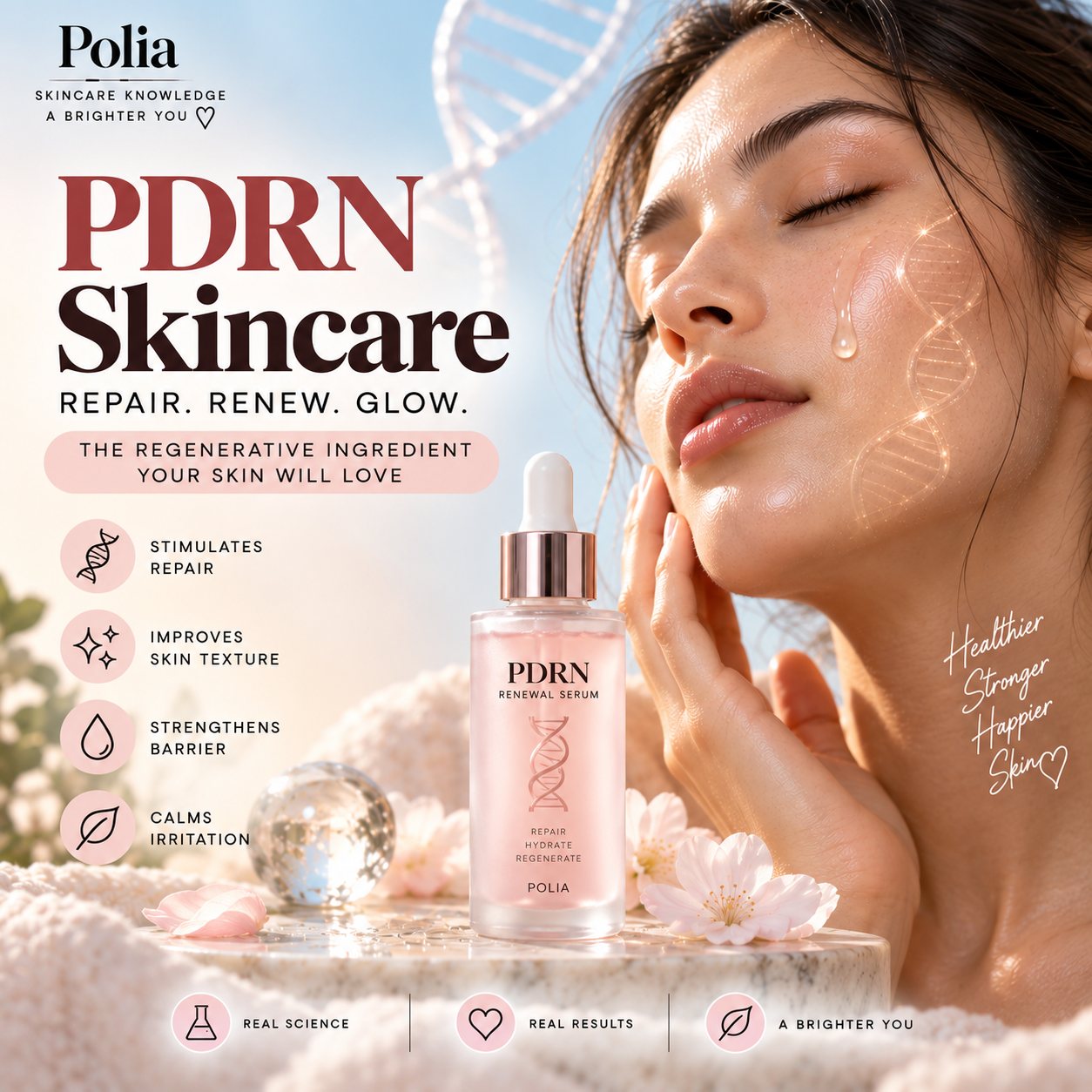
PDRN has gone from a relatively obscure regenerative ingredient to one of the biggest skincare trends in K-beauty and aesthetic medicine.
Thank you for reading this post, don’t forget to subscribe!You’ve probably seen it called PDRN serum, salmon DNA, salmon sperm skincare, or regenerative skincare.
But what does PDRN actually do?
Can a PDRN serum really repair your skin? Is topical PDRN comparable to the injectable treatments used in clinics? And do you actually need it?
The short answer: PDRN is scientifically interesting, but the evidence depends heavily on how it is delivered.
Let’s separate the clinical science from the skincare marketing.
The Short Answer
PDRN stands for polydeoxyribonucleotide, a mixture of purified DNA fragments.
Research has linked PDRN with biological processes involved in tissue repair, including signaling through adenosine A2A receptors and nucleotide salvage pathways. Most of the strongest evidence historically comes from wound healing and clinical applications rather than ordinary cosmetic serums.
More recent research is beginning to investigate topical PDRN directly, including a 2026 randomized split-face study of a topical PDRN preparation compared with retinol. The results were promising, but this is still an emerging evidence base rather than proof that every PDRN serum will produce dramatic results.
So PDRN isn’t a miracle ingredient.
But it isn’t just marketing hype either.
The important question is what form of PDRN you’re using, how it is formulated, and what you’re expecting it to do.
What Is PDRN, Exactly?
PDRN stands for polydeoxyribonucleotide.
It consists of purified DNA-derived fragments, traditionally produced from salmon or trout sources. Medical-grade PDRN has been studied for tissue repair and wound healing for decades.
The popular phrase “salmon sperm skincare” makes the ingredient sound much stranger than it actually is.
PDRN is not raw sperm.
It is a purified DNA-derived material that undergoes processing to remove unwanted biological components.
The important distinction is that not every cosmetic product marketed as “PDRN” is identical to the PDRN used in clinical research.
Molecular size, concentration, formulation, delivery system, and route of administration can all affect what the ingredient actually does.
That’s one reason you should be cautious about comparing a topical serum directly with an injectable treatment.
How Does PDRN Work?
PDRN has been studied through two major biological pathways.
1. Adenosine A2A receptor signaling
Research suggests PDRN can activate adenosine A2A receptors involved in processes such as inflammation regulation, angiogenesis, and tissue repair.
This pathway has been associated with activity involving fibroblasts, endothelial cells, and other cells involved in healing.
2. The nucleotide salvage pathway
PDRN can also provide nucleotide building blocks that cells can reuse through the salvage pathway.
In simple terms, researchers believe this may help support cellular processes involved in tissue repair.
That sounds impressive, but remember:
A biological mechanism does not automatically mean a dramatic cosmetic result.
What happens in laboratory models, wound-healing studies, injections, and a cosmetic serum applied to intact skin are not necessarily the same thing.
What Does PDRN Actually Do for Skin?
Research into PDRN and related polynucleotide treatments has explored several potential benefits, including:
- Supporting wound healing
- Supporting tissue regeneration
- Modulating inflammatory responses
- Supporting collagen and extracellular-matrix processes
- Improving certain measures of skin quality
- Supporting recovery after certain procedures
A 2026 systematic review of randomized clinical trials found promising results for PDRN and polynucleotide treatments in wound healing, scar management, and skin rejuvenation, but emphasized that the studies were small and used different formulations and protocols.
That distinction matters.
Promising evidence is not the same thing as definitive evidence.
Topical PDRN vs Injectable PDRN: The Difference Matters
This is probably the most important section of the entire article.
Injectable or clinical PDRN
Clinical PDRN has been studied in situations involving wound healing and tissue regeneration, where the material is delivered in ways that bypass the normal surface barrier.
This is where much of the historical evidence comes from.
Topical PDRN
A serum or cream is applied to the surface of the skin.
For years, one of the major questions was whether PDRN could meaningfully reach viable skin layers when applied topically.
New research is beginning to investigate this directly. A 2026 study of a topical PDRN preparation reported evidence of distribution into viable epidermal regions and promising improvements in several measures of photodamaged skin in a small randomized split-face trial.
That’s encouraging.
But it doesn’t mean every “PDRN serum” on the market will behave the same way.
The takeaway: topical PDRN is an interesting and increasingly studied category, but don’t expect a cosmetic serum to automatically reproduce the results of a clinical injectable treatment.
PDRN vs Polynucleotides: Are They the Same?
You’ll often see PDRN and PN (polynucleotides) used almost interchangeably online.
They’re related, but they aren’t necessarily identical.
Both are DNA-derived materials, but differences in molecular characteristics can affect their biological behavior and proposed applications.
Recent dermatology reviews distinguish PDRN from longer-chain polynucleotides, with PDRN being more closely associated with adenosine-receptor signaling and nucleotide salvage mechanisms, while PN products are often discussed in relation to extracellular-matrix remodeling.
For shoppers, the practical lesson is simple:
Don’t judge a product solely by whether the label says PDRN, PN, or “salmon DNA.”
Look at the actual ingredient list, formulation, manufacturer information, and evidence behind the specific product.
PDRN vs Retinol: Which Should You Choose?
This isn’t really a competition.
They work differently.
| Feature | PDRN | Retinoids |
|---|---|---|
| Main interest | Repair and regenerative signaling | Cell turnover and long-term skin changes |
| Irritation potential | Often formulated as a gentle skincare step | Can cause irritation, especially when starting |
| Best known research | Wound healing and regenerative applications | Acne, photoaging and skin texture |
| Best for | People interested in hydration, barrier support and regenerative skincare | People targeting acne, texture or photoaging |
| Can they coexist? | Often can, depending on the formula and tolerance | Introduce gradually and avoid overwhelming irritated skin |
If your skin is already irritated, adding several new actives at once isn’t a good strategy.
If your skin tolerates retinoids well, PDRN can be considered an optional complementary ingredient rather than a replacement.
And if you’re new to skincare, you don’t need either ingredient to build a good routine.
Start with the basics.
Can PDRN Help a Compromised Skin Barrier?
This is where PDRN gets particularly interesting—but also where skincare marketing can become misleading.
If your skin is:
- Stinging when products are applied
- Unusually tight
- Flaking
- Red or uncomfortable
- More reactive than normal
the first step shouldn’t automatically be another serum.
A simpler routine may be more appropriate.
Your skin-barrier reset guide explains this approach in detail: temporarily simplifying cleansing, moisturizing, and sun protection while pausing common sources of irritation such as exfoliating acids and retinoids.
[Read the full 7-Day Skin Barrier Repair Routine →]
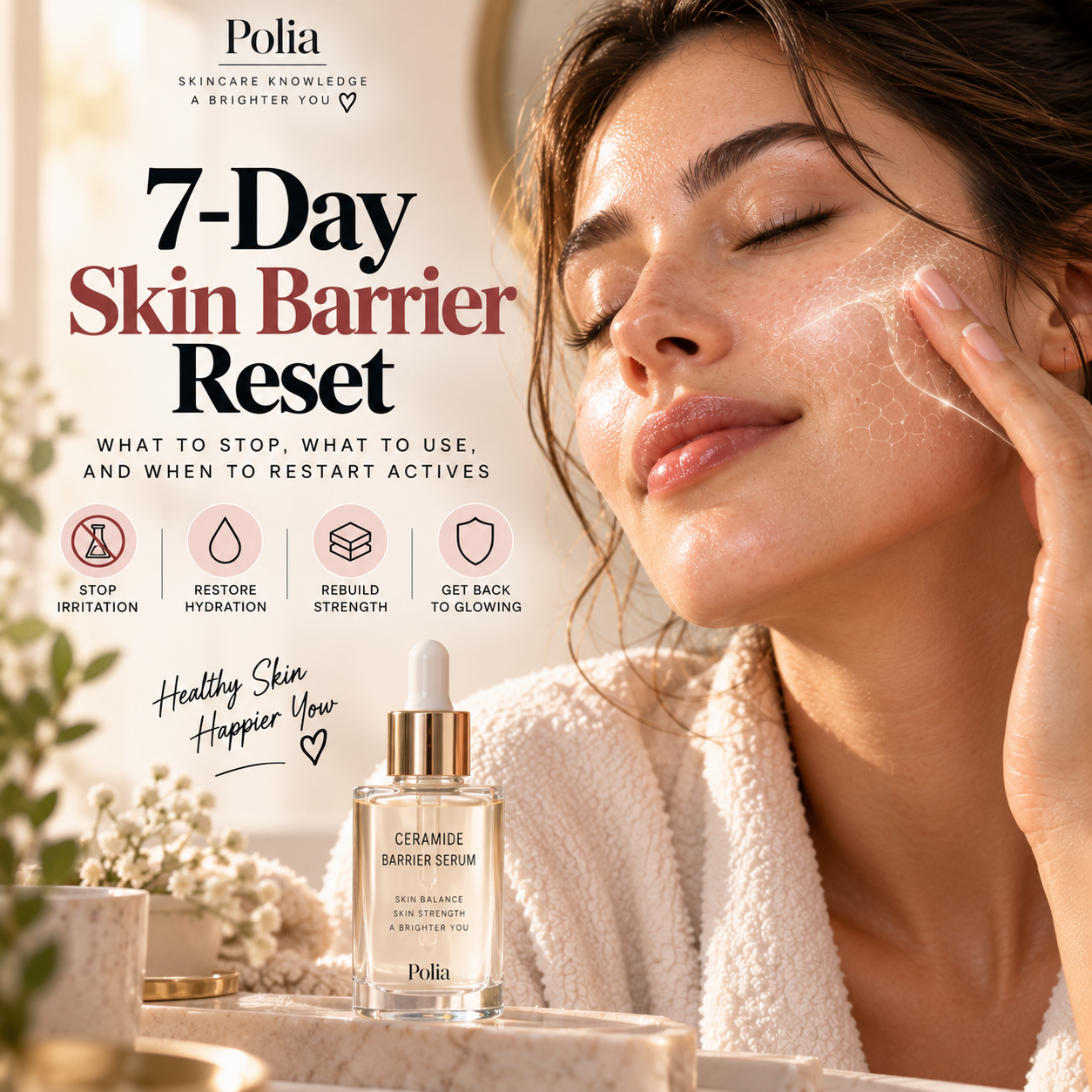
PDRN may be an interesting addition once your skin is comfortable with the basics, but it shouldn’t be treated as a guaranteed cure for every rash, irritation, or skin condition.
Persistent, worsening, painful, swollen, oozing, crusting, or eye-area symptoms deserve professional evaluation rather than simply adding more skincare.
How to Add PDRN to Your Skincare Routine
If your skin tolerates the product, PDRN is generally easiest to incorporate as a serum or essence step.
A simple framework is:
Morning
- Gentle cleanser or water rinse
- Hydrating toner/essence if desired
- PDRN serum
- Moisturizer
- Broad-spectrum SPF
Evening
- Cleanser
- Hydrating toner/essence if desired
- PDRN serum
- Moisturizer
If you’re also using retinoids or exfoliating acids, don’t assume that adding another active automatically makes the routine better.
For a complete explanation of what goes first, what goes last, and where treatment serums belong, see our guide to [the exact skincare routine order for morning and night →].
The principle is simple:
Cleanse → treatments → moisturize → protect.
And in the morning, sunscreen is the final protective step.
PDRN and Glass Skin: Do You Actually Need It?
Not at all.
PDRN can be part of a hydration-focused routine, but it isn’t a requirement for healthy-looking, luminous skin.
Your skin’s appearance is influenced by hydration, surface texture, barrier function, sun protection, genetics, and many other factors.
That’s why a beginner routine can work perfectly well without PDRN.
If you’re starting from scratch, our [Glass Skin for Beginners: 5-Step Drugstore Routine →] is a better place to start than buying several trending serums at once.
And if you already have the basics under control, you can explore our more detailed [7-Step Glass Skin Routine →] for ideas on layering hydration and treatment products.
The goal shouldn’t be to collect every trending ingredient.
Build a routine your skin can tolerate and that you can actually maintain.
What Should You Look For in a PDRN Serum?
Don’t choose a product simply because the bottle says “PDRN 100,” “salmon DNA,” or another impressive-sounding concentration.
Marketing terminology isn’t standardized enough for the label alone to tell you how effective a product will be.
Instead, look for:
- A clearly disclosed ingredient list
- PDRN or sodium DNA identified in the formula
- A reputable manufacturer
- Transparent information about the formulation
- Complementary hydrating ingredients such as glycerin, panthenol or hyaluronic acid
- Barrier-supportive ingredients when appropriate
- Clear usage instructions
And remember:
A higher advertised number doesn’t automatically mean a better product.
What About Vegan PDRN?
Plant-derived or “vegan PDRN” products have become increasingly popular.
However, the evidence shouldn’t be assumed to be identical to traditional salmon- or trout-derived PDRN simply because both products use the word PDRN.
The source material, processing, molecular characteristics, formulation, and clinical evidence all matter.
If you’re choosing a vegan product, look for transparent information about what the manufacturer actually means by “PDRN” and what evidence supports that particular formulation.
How Long Does PDRN Take to Work?
This is one area where skincare marketing tends to promise more certainty than the evidence supports.
You may notice hydration or cosmetic improvements relatively quickly from a well-formulated serum, but that doesn’t necessarily mean PDRN itself has produced a regenerative change.
Longer-term outcomes depend on the formulation, consistency, skin condition, and what else you’re using.
Rather than promising a universal:
“PDRN works in 7 days.”
a more honest approach is:
Give a new routine time to settle, monitor how your skin responds, and evaluate it over several weeks rather than expecting an overnight transformation.
Recent clinical research is promising, but larger and better-standardized studies are still needed to determine exactly which topical PDRN formulations provide meaningful benefits and for whom.
Common PDRN Skincare Mistakes
1. Expecting injectable results from a serum
Topical and injectable PDRN are different delivery methods.
2. Adding PDRN on top of an already overloaded routine
More products don’t automatically mean better skin.
3. Using PDRN to “repair” skin while continuing to irritate it
If you’re aggressively exfoliating while your skin is stinging, adding another serum misses the bigger problem.
4. Ignoring sunscreen
No regenerative serum can replace daily UV protection.
5. Choosing a product based entirely on the PDRN number
Concentration claims don’t tell the whole formulation story.
6. Confusing PDRN with PN
They’re related but can refer to different materials and formulations.
7. Expecting perfect skin
Healthy skin can have pores, texture, redness, blemishes, and imperfections.
A good skincare routine is about supporting your skin—not trying to erase every normal feature.
Who Might Want to Try PDRN?
PDRN may be worth exploring if you:
- Like gentle, hydration-focused skincare
- Want to experiment with regenerative skincare ingredients
- Have a routine built around barrier support
- Are interested in newer K-beauty ingredients
- Prefer a serum that can complement rather than replace your basic routine
You may not need it if:
- Your current routine already works well
- You’re just beginning skincare
- You’re dealing with significant irritation
- You’re buying it solely because of viral marketing
- You’re expecting dramatic results immediately
The Bottom Line
PDRN is one of the more interesting ingredients to emerge from the regenerative-skincare trend.
The science behind PDRN is real, particularly in wound-healing and tissue-repair research. Newer research into topical applications is also encouraging.
But the honest story is more nuanced than the marketing.
PDRN isn’t a miracle.
It isn’t necessarily a scam either.
It’s a developing skincare category with a plausible biological mechanism, a growing clinical literature, and promising—but still limited—evidence for many cosmetic applications.
If you want to try it, think of PDRN as an optional addition to a well-built routine, not the foundation of one.
Start with gentle cleansing, adequate moisturization, and daily SPF.
Then add treatments based on what your skin actually needs.
And if your skin is irritated, simplify first.
Healthy skin doesn’t require the most complicated routine. It requires the right routine, used consistently.
Frequently Asked Questions
Is PDRN actually good for skin?
PDRN has promising research behind it, particularly in tissue repair and wound healing. Research into topical PDRN is growing, but cosmetic results depend on the specific formulation and delivery method.
Is PDRN better than retinol?
Not necessarily. They serve different purposes. Retinoids have a much larger evidence base for acne and photoaging, while PDRN is primarily being investigated for regenerative and tissue-repair applications.
Can I use PDRN every day?
Many cosmetic PDRN products are designed for regular use, but follow the specific product’s directions. If your skin becomes irritated after introducing it, stop and reassess rather than pushing through.
Can PDRN repair a damaged skin barrier?
PDRN may support processes involved in skin repair, but it shouldn’t be considered a guaranteed treatment for every type of irritation or skin condition. A simplified, barrier-friendly routine is often the better starting point when skin is reactive.
Can I use PDRN with retinol?
They can potentially be used in the same overall routine, but introducing multiple actives at once can make irritation harder to identify. If you’re new to either ingredient, introduce products gradually.
Is PDRN the same as salmon sperm?
No. The popular phrase refers to the historical source of some PDRN materials. Cosmetic and medical PDRN is purified DNA-derived material, not raw sperm.
Do I need PDRN for glass skin?
No. Hydration, barrier support, gentle skincare, and consistent sun protection are more fundamental. PDRN is optional.
This article is for informational purposes only and is not a substitute for professional medical advice. If you have persistent, severe, worsening, or unusual skin symptoms, consult a qualified healthcare professional or dermatologist.
Related posts:
 Plump & Perfect: 18 Natural Ways to Get Fuller Lips Without Fillers! 💋✨
 🌸 21 Effortlessly Chic Spring Outfits You’ll Want to Wear All Season Long (trend Edition)
 ✨ 17 Balayage Ideas for Long, Layered Brunette Hair with Face Framing ✨
 How Colors Can Instantly Transform Your Look and Boost Your Confidence ✨