
Your skin suddenly stings when you apply moisturizer. Products you’ve used for months now burn. Your face feels tight after cleansing, looks red or flaky, or seems unusually sensitive.
Thank you for reading this post, don’t forget to subscribe!If that sounds familiar, your skin may be irritated and your barrier may be impaired.
The solution usually isn’t another serum, stronger exfoliant, or complicated 10-step routine.
It’s a reset.
This 7-day skin barrier reset is designed to help you simplify your routine, remove common sources of irritation, support hydration, and give your skin time to settle.
One important distinction: seven days is a reset period, not a guarantee that your skin barrier will be completely repaired in seven days. Mild irritation may improve quickly, while more significant irritation or an underlying skin condition can take longer and may need professional treatment.
The Quick Answer: What Should You Do for a Damaged Skin Barrier?
For the next seven days, keep your routine deliberately boring:
Morning
- Gentle cleanse or lukewarm-water rinse
- Simple hydrating product, if comfortable
- Fragrance-free moisturizer
- Broad-spectrum SPF 30+
Evening
- Gentle cleanser
- Simple moisturizer
- Optional thin layer of petrolatum or another suitable occlusive if your skin needs it
And temporarily pause products that are likely to add irritation, especially:
- Exfoliating acids
- Retinoids
- Physical scrubs
- Strong or irritating treatments
- Fragranced products if they bother your skin
- Hot water
- Excessive cleansing
- Constantly introducing new products
The goal isn’t to replace every product in your bathroom.
The goal is to remove unnecessary variables and give your skin fewer things to react to.
What Is the Skin Barrier?
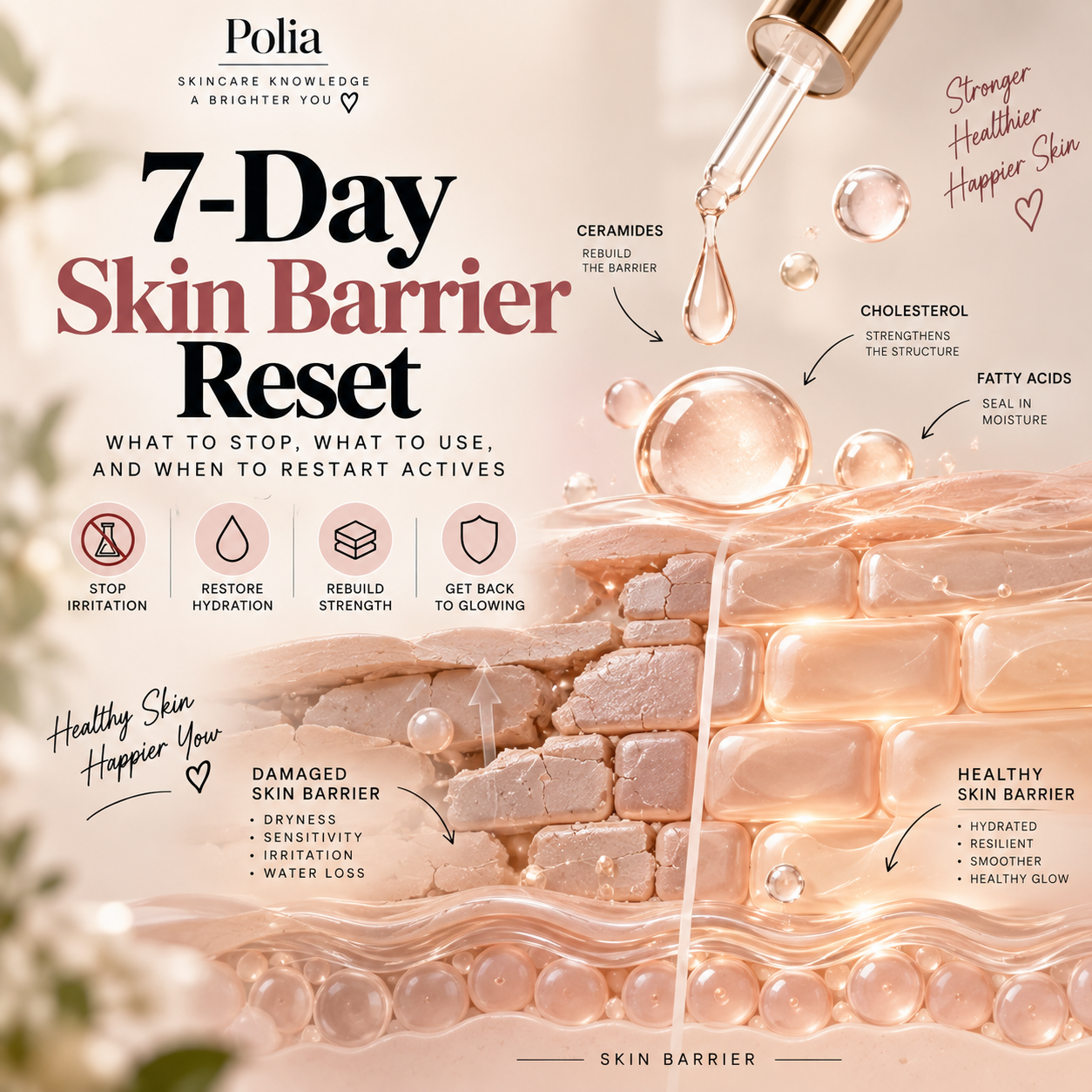
Think of the outermost layer of your skin as a highly organized protective wall.
The cells of the outer skin layer, called corneocytes, form the “bricks.” Between them is a lipid-rich matrix containing substances such as ceramides, cholesterol, and fatty acids that help form the “mortar.”
This structure helps your skin retain water while limiting the penetration of environmental irritants and other substances. One way scientists assess barrier function is through transepidermal water loss (TEWL) — the movement of water from inside the skin toward the environment.
When this protective system is disrupted, skin can become:
- Drier
- More sensitive
- More easily irritated
- Tight or uncomfortable
- More reactive to products you previously tolerated
That’s why your normal routine can suddenly feel completely different.
A moisturizer that was perfectly comfortable last month may suddenly sting.
An exfoliant that once made your skin feel smooth may now leave it feeling raw.
And adding even more products can make the cycle worse.
How Do You Know If Your Skin Barrier May Be Irritated?
There isn’t one symptom that proves your skin barrier is damaged.
Instead, look for a pattern of changes.
Common signs of irritation or impaired barrier function can include:
1. Stinging or burning
Products that normally feel comfortable suddenly sting when applied.
2. Sudden sensitivity
Your skin begins reacting to products you previously tolerated.
3. Tightness
Your face feels uncomfortable or unusually tight after cleansing.
4. Dryness or flaking
Your skin becomes rough, flaky, or visibly dry.
5. Redness
You notice more redness or flushing than usual.
6. Rough texture
Your skin feels uneven instead of smooth.
7. Itching or irritation
Your skin feels persistently uncomfortable or irritated.
8. Breakouts alongside irritation
You may notice blemishes while your skin is simultaneously dry, sensitive, or inflamed.
Important: These symptoms aren’t specific to a damaged barrier. Eczema, contact dermatitis, acne treatments, rosacea, allergies, infections, and other skin conditions can produce similar symptoms.
So don’t use a symptom checklist as a diagnosis.
Instead, use it as a signal to simplify your routine and pay attention to how your skin responds.
Why Your Skincare Routine May Have Caused the Problem
Sometimes the problem isn’t one “bad” product.
It’s the total amount of irritation your skin is receiving.
For example:
- Retinoid at night
- Exfoliating acid the next morning
- Vitamin C
- Scrub once or twice a week
- Cleansing device
- Multiple treatment serums
- Frequent product switching
- Fragranced products
- Hot water
Each step may seem reasonable on its own.
Together, they can become too much for your skin.
Dermatologists also caution that using too many products can irritate skin, particularly when several treatment products are layered together.
That’s why the first step in barrier recovery isn’t finding a stronger treatment.
It’s removing unnecessary stress.
The 7-Day Skin Barrier Reset
This protocol has three simple phases:
Days 1–2: CALM
Remove unnecessary irritation.
Days 3–5: REBUILD
Focus on hydration and moisturization.
Days 6–7: STABILIZE
Keep the routine simple and assess how your skin responds.
Again, seven days isn’t a promise of complete recovery.
Think of it as a structured reset that gives irritated skin a chance to settle.
Days 1–2: CALM
Your goal
Do less.
For the first two days, resist the urge to “fix” your skin with additional treatments.
Morning
Step 1: Cleanse gently — or simply rinse
If your skin feels very dry or reactive, a lukewarm-water rinse may be enough in the morning.
Otherwise, use a gentle cleanser that doesn’t leave your skin feeling stripped.
Step 2: Hydrating layer — optional
If you already own a simple, fragrance-free hydrating toner or essence that doesn’t sting, you can use it.
But this step is not necessary.
If a toner stings, skip it.
Step 3: Moisturizer
Apply a comfortable moisturizer while your skin is slightly damp.
Look for a simple formula designed to support dry or sensitive skin. Ceramides, glycerin, dimethicone, and other moisturizing ingredients can be useful depending on the formula and your skin.
Step 4: Sunscreen
Finish with broad-spectrum sunscreen rated SPF 30 or higher when you’re going outside or otherwise need sun protection.
Sunscreen remains an important part of a basic skincare routine.
Evening
Step 1: Gentle cleanser
Wash away sunscreen, makeup, and the day’s buildup without aggressive scrubbing.
Use lukewarm rather than hot water.
Step 2: Moisturizer
Apply your barrier-friendly moisturizer to slightly damp skin.
Step 3: Optional occlusive
If your skin is particularly dry, you can consider a thin layer of petrolatum over moisturizer on areas that need extra protection.
You don’t have to slug your entire face.
And if an occlusive makes your skin feel uncomfortable or seems to worsen breakouts, skip it.
Occlusives such as petrolatum work primarily by reducing evaporative water loss from the skin’s surface.
For Days 1–2, skip:
- Retinoids
- Exfoliating acids
- Physical scrubs
- Exfoliating brushes
- Strong treatment serums
- Products that sting
- New skincare experiments
Your routine should feel almost boring. That’s the point.
Days 3–5: REBUILD
If your skin is beginning to feel more comfortable, keep doing exactly what is working.
Do not interpret early improvement as a signal to restart everything.
Morning
- Gentle cleanser or water rinse
- Optional simple hydrating layer
- Moisturizer
- Broad-spectrum SPF 30+
What about niacinamide?
Niacinamide can support the skin barrier and has evidence for effects on skin lipids and hydration.
However, you do not need to add niacinamide during a flare just because an article says you should.
If your current moisturizer already contains niacinamide and your skin tolerates it, there’s no automatic reason to remove it.
If you’re considering introducing a new niacinamide serum while your skin is irritated, waiting until your skin is calmer may be the smarter choice.
During a reset, simplicity beats optimization.
Evening
- Gentle cleanser
- Moisturizer
- Optional occlusive on dry areas
Continue avoiding exfoliating and retinoid products.
What should your skin feel like?
You’re looking for gradual improvement such as:
- Less tightness
- Less stinging
- Less sensitivity
- Less flaking
- Greater comfort after cleansing
But everyone’s timeline is different.
If your skin is getting worse rather than better, don’t simply push through the protocol.
Days 6–7: STABILIZE
By now, you should have enough information to judge whether simplification is helping.
Morning
- Gentle cleanse or water rinse
- Moisturizer
- SPF 30+
Evening
- Gentle cleanser
- Moisturizer
- Optional occlusive if needed
You can continue a simple hydrating product if it is comfortable, but you don’t need to add more steps just because you’re on Day 6.
The most important question:
Does your skin feel calmer than it did at the beginning?
If yes, continue the simple routine.
If no, don’t assume you simply need a stronger product.
Persistent burning, significant redness, worsening rash, swelling, severe itching, crusting, oozing, pain, or symptoms around the eyes can indicate something other than simple product overload.
🚨 When This May NOT Be a Simple Skin Barrier Problem
A “skin barrier reset” is not a treatment for every facial rash or skin condition.
See a healthcare professional or dermatologist if:
- Symptoms are severe or rapidly worsening
- You develop significant swelling
- You have severe pain
- Your skin is oozing or developing significant crusting
- You suspect an infection
- Your eyes or eyelids are significantly affected
- You have persistent or severe itching
- A rash continues despite simplifying your routine
- Your skin repeatedly flares without an obvious skincare trigger
- You have a diagnosed condition such as eczema or rosacea that isn’t responding to your usual care
Also remember:
Burning does not automatically mean “damaged barrier.”
It can have several causes.
If simplifying your skincare routine isn’t helping, getting the correct diagnosis matters more than adding another moisturizer.
What Ingredients Should You Look For?
Forget the idea that one ingredient is going to magically “repair” your skin.
A good barrier-supporting moisturizer is usually about the overall formulation, not one hero ingredient.
Ceramides
Ceramides are naturally occurring lipids that form an important part of the skin’s outer barrier.
They’re commonly used in moisturizers designed for dry or compromised skin.
Cholesterol and fatty acids
These are also important components of the skin’s intercellular lipid matrix.
Some formulations combine ceramides, cholesterol, and fatty acids to support the structure of the outer skin layer.
But you don’t need to obsess over a specific ratio printed on a product label.
Formulation quality matters more than chasing a number.
Glycerin
Glycerin is a humectant that helps attract and retain water.
It’s a common and useful ingredient in moisturizing products.
Panthenol
Panthenol, also known as provitamin B5, is commonly used in products formulated for hydration and skin comfort.
Petrolatum
Petrolatum is an occlusive ingredient that helps reduce water loss from the skin.
It can be useful for very dry areas, particularly when layered over moisturizer.
Niacinamide
Niacinamide can support the skin barrier and may help increase ceramide and other lipid production.
But more isn’t necessarily better.
If your skin is currently very reactive, don’t assume that a high-strength niacinamide serum will repair it faster.
What About Hyaluronic Acid?
Yes, you can use a hydrating product containing hyaluronic acid if your skin tolerates it.
But don’t make it the centerpiece of your repair strategy.
Hyaluronic acid is primarily a hydrating ingredient.
It doesn’t replace the role of a moisturizer or occlusive layer.
A simple routine might therefore look like:
Hydrating ingredient → moisturizer → optional occlusive
But if your moisturizer alone feels comfortable, you don’t need the extra step.
What Should You Avoid During the Reset?
You don’t need to create a giant “forbidden ingredients” list.
Instead, focus on the biggest sources of potential irritation.
Pause exfoliating acids
That includes products containing AHAs, BHAs, PHAs, and other exfoliating treatments.
Pause retinoids
Give your skin a break from retinol and prescription or over-the-counter retinoid products unless your healthcare professional has specifically told you otherwise.
Pause physical exfoliation
Skip:
- Scrubs
- Brushes
- Cleansing devices
- Aggressive towels
- Picking or peeling flakes
Be cautious with fragrance
Fragrance can irritate sensitive or dry skin, so fragrance-free products are generally the safer choice during a reset.
Avoid hot water
Use lukewarm water instead.
Stop constantly changing products
This one is underrated.
If you change five products at once, you won’t know what helped or what caused another reaction.
How to Choose a Barrier-Friendly Moisturizer
You don’t need the most expensive “barrier repair” cream on the shelf.
Instead, look for a moisturizer that:
- Feels comfortable on your skin
- Doesn’t sting when applied
- Is fragrance-free if fragrance irritates you
- Contains effective moisturizing ingredients
- Matches your skin’s texture preferences
- Doesn’t leave you excessively dry or uncomfortable
- Is non-comedogenic if you’re prone to clogged pores
Creams and ointments can be particularly useful for very dry skin, while lighter lotions or gels may be more comfortable for some people with oilier skin. There isn’t one moisturizer texture that works for everyone.
The best moisturizer is the one your skin tolerates and you can use consistently.
Don’t Confuse “More Barrier Products” With Better Barrier Care
One of the easiest mistakes is turning a minimalist repair routine into another 10-step routine.
You start with:
Cleanser → moisturizer
Then add:
Toner → essence → serum → barrier serum → ceramide cream → facial oil → balm → sleeping mask
Now you’re back where you started: too many variables.
A damaged or irritated barrier doesn’t need a complicated recovery stack.
It needs consistent, comfortable basics.
Common Skin Barrier Mistakes
1. Restarting actives the moment your skin feels better
Feeling better doesn’t necessarily mean your skin is ready for every active again.
Wait until your skin is consistently comfortable with your basic routine.
2. Using a “gentle” acid anyway
An acid is still an exfoliating treatment.
During a reset, don’t try to sneak exfoliation back in through a product marketed as “mild.”
3. Buying five new barrier products
You don’t need a new routine just because your old one irritated you.
Start with the simplest products you already tolerate.
4. Cleansing aggressively
Clean skin should not feel squeaky, tight, or stripped.
5. Scrubbing away flakes
Flaking can be tempting to remove.
Don’t.
Let your skin settle rather than mechanically removing the surface.
6. Skipping moisturizer because you have oily skin
Oily skin can still become dehydrated or irritated.
If your skin is oily, choose a lighter moisturizer rather than automatically skipping moisturizer.
7. Forgetting sunscreen
Daily sun protection remains an important part of maintaining healthy skin and protecting irritated or dry skin from additional environmental stress.
How Long Does Skin Barrier Repair Take?
This is where skincare advice often becomes misleading.
There is no universal seven-day repair clock.
Some mild irritation caused by over-exfoliation or product overload may feel noticeably better within several days after removing the trigger.
More significant irritation can take weeks.
Underlying conditions such as eczema or rosacea may require a completely different approach.
So instead of asking:
“Will my skin barrier be fixed in seven days?”
Ask:
“Is my skin becoming progressively calmer as I simplify my routine?”
That’s the more useful measure.
When Should You Restart Retinol, Vitamin C, or Exfoliants?
Don’t restart everything at once.
Your first priority is getting back to a routine that your skin comfortably tolerates.
Once your skin is consistently calm — meaning your basic cleanser and moisturizer no longer cause unusual stinging or irritation — you can consider reintroducing treatments gradually.
The One-Active-at-a-Time Rule
Instead of:
Monday: retinol
Tuesday: acid
Wednesday: vitamin C
Thursday: retinol again
Try:
One active → observe → maintain → then consider the next.
You don’t need to introduce a new active every week.
And you don’t need to follow a rigid “one active per month” rule either.
The right pace depends on the product, your skin, and how you respond.
A Safer Reintroduction Order
There’s no universal medically required order for every person.
But if you’re rebuilding a routine after irritation, a conservative approach is to introduce one treatment at a time, starting with the product you actually need most.
For example:
Step 1: Re-establish your basic routine
Cleanser → moisturizer → SPF
Step 2: Introduce one treatment
Use it less frequently than you previously did if irritation was the problem.
Step 3: Observe
Give your skin enough time to show whether it tolerates the product.
Step 4: Add another treatment only if necessary
Don’t add something simply because it’s trending.
What About the Retinol Sandwich Method?
If retinol is appropriate for you and you have been advised to use it, applying moisturizer before and after retinoid can be one strategy to help reduce irritation.
The basic concept is:
Moisturizer → Retinoid → Moisturizer
But this is not a requirement for everyone, and it doesn’t make retinoids automatically irritation-proof.
If your skin is currently irritated, pause the retinoid rather than trying to make it work through the irritation.
What About Skin Cycling?
Skin cycling is often presented as a fixed four-night schedule:
Night 1: Exfoliation
Night 2: Retinoid
Night 3: Recovery
Night 4: Recovery
That can be a useful framework for some people.
But it isn’t a universal prescription.
If your skin became irritated because you were using too many actives, immediately jumping into another structured active schedule may simply recreate the same problem.
Start with recovery.
Then decide whether you actually need multiple actives in the first place.
Your Simple Skin Barrier Routine Cheat Sheet
MORNING
Very reactive skin
Water rinse
↓
Moisturizer
↓
SPF
Less reactive skin
Gentle cleanser
↓
Moisturizer
↓
SPF
EVENING
Gentle cleanser
↓
Moisturizer
↓
Optional petrolatum/occlusive on dry areas
That’s enough.
You don’t need eight steps for your skin to recover.
Frequently Asked Questions
Can niacinamide repair a damaged skin barrier?
Niacinamide can support barrier function and has evidence for effects on skin lipids and hydration.
But it isn’t a magic repair treatment.
If your skin is actively irritated, don’t assume adding a new niacinamide serum is necessary. Your moisturizer may already contain it.
Can I use hyaluronic acid while repairing my barrier?
Yes, if your skin tolerates it.
Hyaluronic acid is primarily a humectant that helps support hydration.
It doesn’t replace a moisturizer.
Can I slug if I have oily or acne-prone skin?
You can use petrolatum on dry areas if your skin tolerates it, but you don’t have to cover your entire face.
If heavy occlusion makes your skin feel congested or uncomfortable, use less or skip it.
Choose your routine based on how your skin responds rather than following a trend blindly.
Should I stop moisturizer if I’m breaking out?
Not necessarily.
Irritated and dehydrated skin can still need moisturization.
If you’re acne-prone, look for a moisturizer labeled non-comedogenic or one that you know your skin tolerates. Moisturizers can also help skin tolerate drying acne treatments.
Can I use sunscreen during a skin barrier reset?
Yes, provided you tolerate the sunscreen.
A broad-spectrum SPF 30+ product is a basic part of healthy skincare and should not automatically be removed because your skin is irritated.
If your usual sunscreen stings, consider whether another formula is more comfortable rather than abandoning sun protection altogether.
Should I use a sheet mask?
Only if it’s genuinely simple and comfortable.
A hydrating mask can be an optional extra, but it’s not required for barrier recovery.
Avoid masks containing strong exfoliating, fragranced, or otherwise irritating ingredients while your skin is reactive.
Can I use a barrier cream with retinol?
Yes, moisturizer can be used alongside retinoids and may help improve tolerability.
But if your skin is currently irritated, don’t use the moisturizer as a reason to keep applying the retinoid.
Repair first. Reintroduce the active later.
How do I know when my barrier is ready for actives again?
Look for consistency rather than one good day.
Your basic routine should feel comfortable.
You should no longer have persistent unusual stinging, significant flaking, or worsening irritation from your ordinary moisturizer.
When your skin is consistently calm, introduce one active at a time and go slowly.
The 7-Day Skin Barrier Reset: Your Final Checklist
DAYS 1–2
CALM
- Simplify
- Gentle cleanse
- Moisturize
- SPF
- Pause actives
- Avoid scrubs
- Avoid hot water
- Don’t pick flakes
DAYS 3–5
REBUILD
- Continue the simple routine
- Keep skin moisturized
- Continue SPF
- Add nothing unnecessary
- Don’t restart actives just because you’re impatient
DAYS 6–7
STABILIZE
- Continue what your skin tolerates
- Assess whether irritation is improving
- Extend the simple routine if needed
- Don’t rush back into a complicated routine
AFTER THE RESET
REINTRODUCE SLOWLY
- One active at a time
- Start conservatively
- Watch your skin’s response
- Don’t chase every skincare trend
- Keep the basics consistent
The Bottom Line
A stressed skin barrier doesn’t need a skincare shopping spree.
It needs less irritation, more consistency, and enough time to settle.
For the next seven days, simplify your routine:
Cleanse gently.
Moisturize consistently.
Protect with SPF.
Pause unnecessary actives.
Stop experimenting.
Then reassess.
If your skin is improving, keep going.
If it isn’t improving — or if you have significant redness, swelling, pain, severe itching, crusting, oozing, eye involvement, or a persistent rash — don’t keep experimenting with skincare. Get professional advice.
And when you’re ready to restart your active products, remember the rule that matters most:
One active at a time. Slowly. Let your skin tell you when it’s ready.
Your best routine isn’t the one with the most products.
It’s the one your skin can actually tolerate consistently.
Medical Disclaimer
This article is for general educational purposes and is not a diagnosis or substitute for professional medical advice. Skin irritation can have many causes, and a “damaged skin barrier” is not a diagnosis that can be confirmed from symptoms alone. If symptoms are severe, persistent, worsening, or associated with significant swelling, pain, crusting, oozing, infection, or eye involvement, consult a qualified healthcare professional or dermatologist.
Related posts:
 Your Ultimate Guide to Stunning Hairstyles: From Classic to Cutting-Edge
 ✨ 17 Balayage Ideas for Long, Layered Brunette Hair with Face Framing ✨
 🌿 The Ultimate Guide to Hair Growth: Proven Tips, Foods & Natural Remedies for Faster, Healthier Hair
 The Exact Skincare Routine Order for Morning and Night (Finally Explained Clearly)