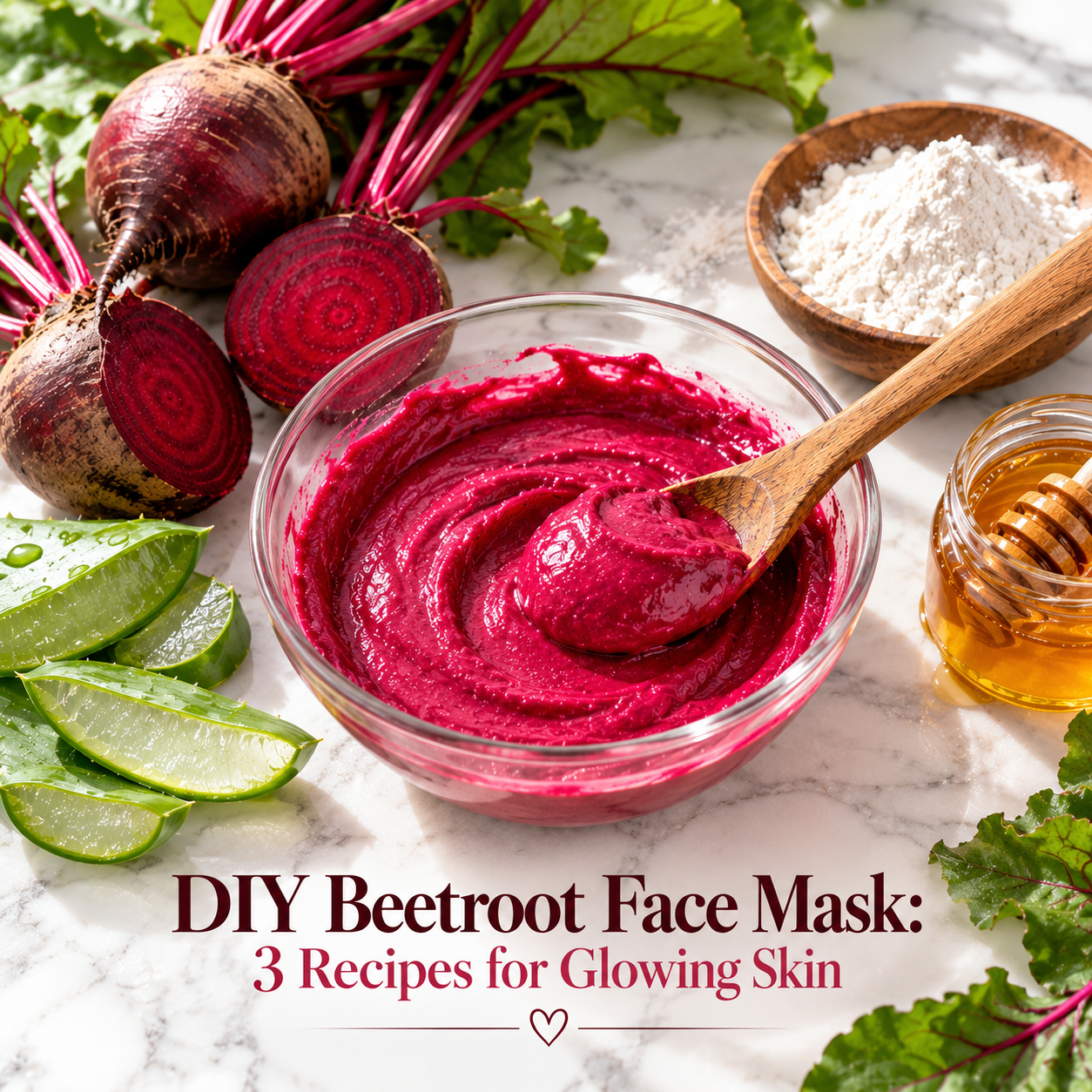
Looking for a simple DIY beetroot face mask for glowing skin? These three homemade recipes combine beetroot with ingredients such as aloe vera, gentle clay, yogurt, and honey. While beetroot masks may temporarily leave skin looking fresh or slightly rosy, they aren’t a proven treatment for dark spots, acne, or permanent “glass skin.” Below, you’ll learn how to make each mask, which one best fits your skin’s needs, and how to use DIY masks safely.
Thank you for reading this post, don’t forget to subscribe!Important: Homemade skincare recipes haven’t undergone the same safety, stability, and efficacy testing as commercially formulated skincare products.
⚠️ Before You Try a Beetroot Face Mask
DIY skincare isn’t automatically safer because the ingredients are natural. Make each mask fresh, patch-test first, avoid broken or irritated skin, and stop immediately if you experience burning, itching, swelling, or persistent redness.
Quick Navigation
- What Beetroot Can—and Can’t—Do
- What Does the Science Say?
- 3 DIY Beetroot Face Mask Recipes
- Choose Your Beetroot Mask
- How to Use a Beetroot Mask Safely
- Where It Fits in Your Skincare Routine
- Who Should Skip DIY Face Masks?
- How Quickly Will You See Results?
- Beetroot Face Mask FAQ
What Beetroot Can—and Can’t—Do
Before we dive into the mixing bowls, let’s manage expectations. There is a lot of misinformation online about what a homemade vegetable mask can achieve. Here is a realistic breakdown:
| Claim | What We Can Realistically Say |
|---|---|
| Makes skin look temporarily brighter | Possible |
| Gives skin a temporary rosy tint | Possible |
| Provides antioxidant compounds | Plausible |
| Hydrates skin | Depends mostly on the other ingredients |
| Fades dark spots | Not established for homemade beetroot masks |
| Shrinks pores | No — pores don’t permanently shrink |
| Removes a tan | No |
| Produces permanent glass skin | No |
| Replaces sunscreen | Absolutely not |
What Does the Science Say?
Instead of calling beetroot a “skincare powerhouse,” let’s look at what it actually contains:
- Betalains: These are antioxidant compounds responsible for beetroot’s characteristic color. However, the benefits of applying beetroot directly to human skin have not been established to the same degree as those of standardized skincare ingredients.
- Vitamin C: Beetroot does contain Vitamin C. However, it’s crucial to understand that homemade beetroot does not deliver the same predictable results as a standardized topical vitamin-C formulation.
- Nitrates: While dietary nitrates affect blood circulation when eaten, claims that applying a beetroot face mask improves facial circulation shouldn’t be presented as an established skincare benefit.
3 DIY Beetroot Face Mask Recipes
Note: If you are using fresh beetroot, prepare only enough for one application. Do not store the finished mask.
🍓 Recipe #1: Beetroot + Aloe Glow Mask
Best for: Dull-looking skin looking for a temporary glow.
Frequency: Once a week initially.
You’ll need:
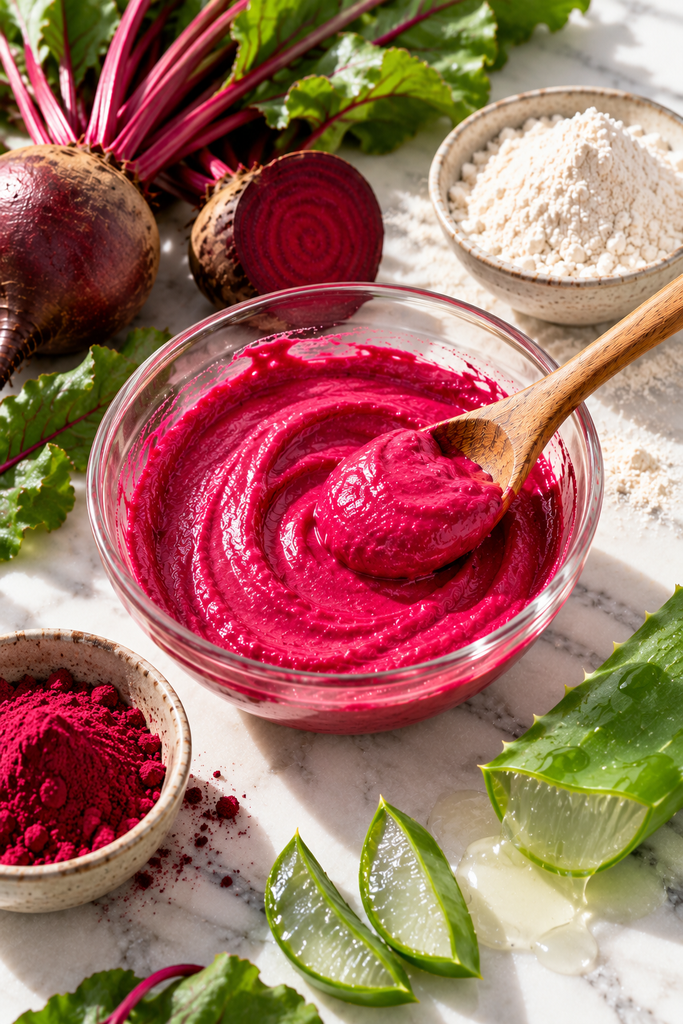
- 1 tbsp Beetroot Powder (cosmetic grade)
- 1 tbsp Aloe Vera Gel
- 1 tbsp Rice Flour
How to make:
- Mix all ingredients in a bowl until you form a smooth, thick paste.
- Apply an even layer to a clean face, avoiding the eye area.
- Relax for 10-15 minutes.
- Rinse off with lukewarm water. If you rinse gently, the rice flour can provide mild physical exfoliation. Avoid scrubbing, especially if your skin is sensitive.
- Follow with moisturizer.
Good to know: This is a cosmetic DIY recipe, not a clinically tested treatment for pigmentation or aging.
🍓 Recipe #2: Beetroot + Clay Oil-Control Mask
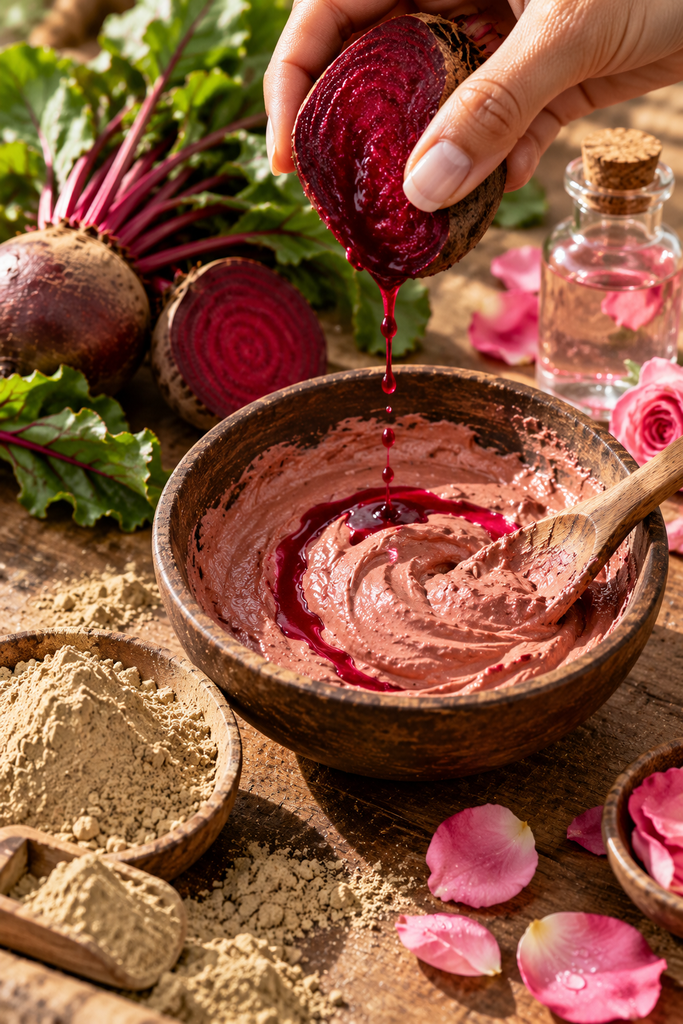
Best for: Oily skin or skin that feels greasy.
Frequency: Once a week initially.
You’ll need:
- 2 tsp Beetroot Juice (freshly extracted)
- 1 tsp Multani Mitti (Fuller’s Earth) or gentle clay
- 1 tsp Rose Water
How to make:
- Mix the clay with the beetroot juice and rose water until smooth.
- Apply evenly to the face and let it dry (about 10-15 minutes). Do not let it crack.
- Rinse with cool water.
Good to know: Clay can be drying. Start with once a week and stop if your skin becomes dry, tight, or irritated. This mask may temporarily leave skin looking fresher and less dull, but it does not “remove” a tan.
🍓 Recipe #3: Beetroot + Yogurt + Honey Hydrating Mask
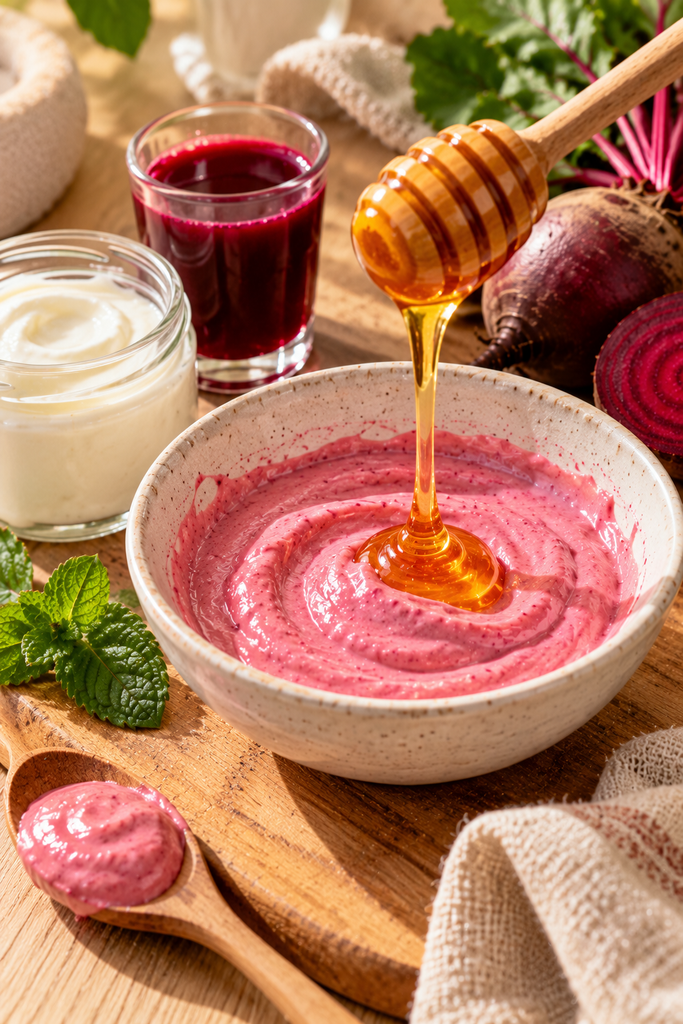
Best for: Dry or dull skin.
Frequency: Once a week initially.
You’ll need:
- 1–2 tbsp fresh beetroot juice
- 2 tbsp plain yogurt
- 1 tbsp honey
How to make:
- Blend the beetroot juice with the yogurt and honey until you get a smooth paste.
- Apply to the face and neck.
- Leave on for 15-20 minutes, then rinse with lukewarm water.
Good to know: Yogurt contains lactic acid, an alpha-hydroxy acid, while honey can help the skin feel softer and more moisturized. However, the strength and consistency of homemade ingredients aren’t standardized, so don’t expect the same predictable results as a formulated skincare product.
Choose Your Beetroot Mask
🌿 Want a simple glow? → Beetroot + Aloe
🧖♀️ Skin feels oily? → Beetroot + Clay
🥛 Skin feels dry? → Beetroot + Yogurt + Honey
⚠️ Sensitive or reactive skin? → Skip DIY masks and choose a fragrance-free, formulated product instead.
How to Use a Beetroot Mask Safely
Patch Test First
Natural doesn’t automatically mean irritation-free. For a new skincare ingredient or product, the American Academy of Dermatology recommends testing a small amount on a discreet area twice daily for 7–10 days.
Because homemade masks aren’t standardized, a patch test cannot guarantee that a facial application will be irritation-free. Stop immediately if you experience redness, itching, swelling, burning, or persistent irritation. The AAD also recommends washing off a facial mask immediately if it causes itching, burning, or stinging.
Do You Need Beetroot Powder?
Not necessarily. For convenience and safety, you can use a cosmetic-grade beetroot powder from a reputable supplier, following its intended use.
Making your own powder at home by drying out pulp is not ideal for skincare. Homemade powders aren’t preserved or standardized for cosmetic use, so their cleanliness, moisture content, and shelf life can be difficult to control. If you’re using fresh beetroot, prepare only enough for one application.
Make DIY Masks Fresh
For homemade masks containing ingredients such as yogurt, aloe, beetroot juice, or other water-rich ingredients, make only the amount you’ll use immediately and discard leftovers.
Homemade mixtures don’t have the controlled preservation systems used in commercial cosmetics, and contamination can occur through ingredients, water, utensils, containers, and fingers. Link to: How Morning Skincare Routine
Where Does It Fit in Your Skincare Routine?
If you are going to use a beetroot mask, here is how to do it safely:
Before:
- Gentle cleanser
- Beetroot mask
- Rinse thoroughly
- Moisturizer
If using it during the day:
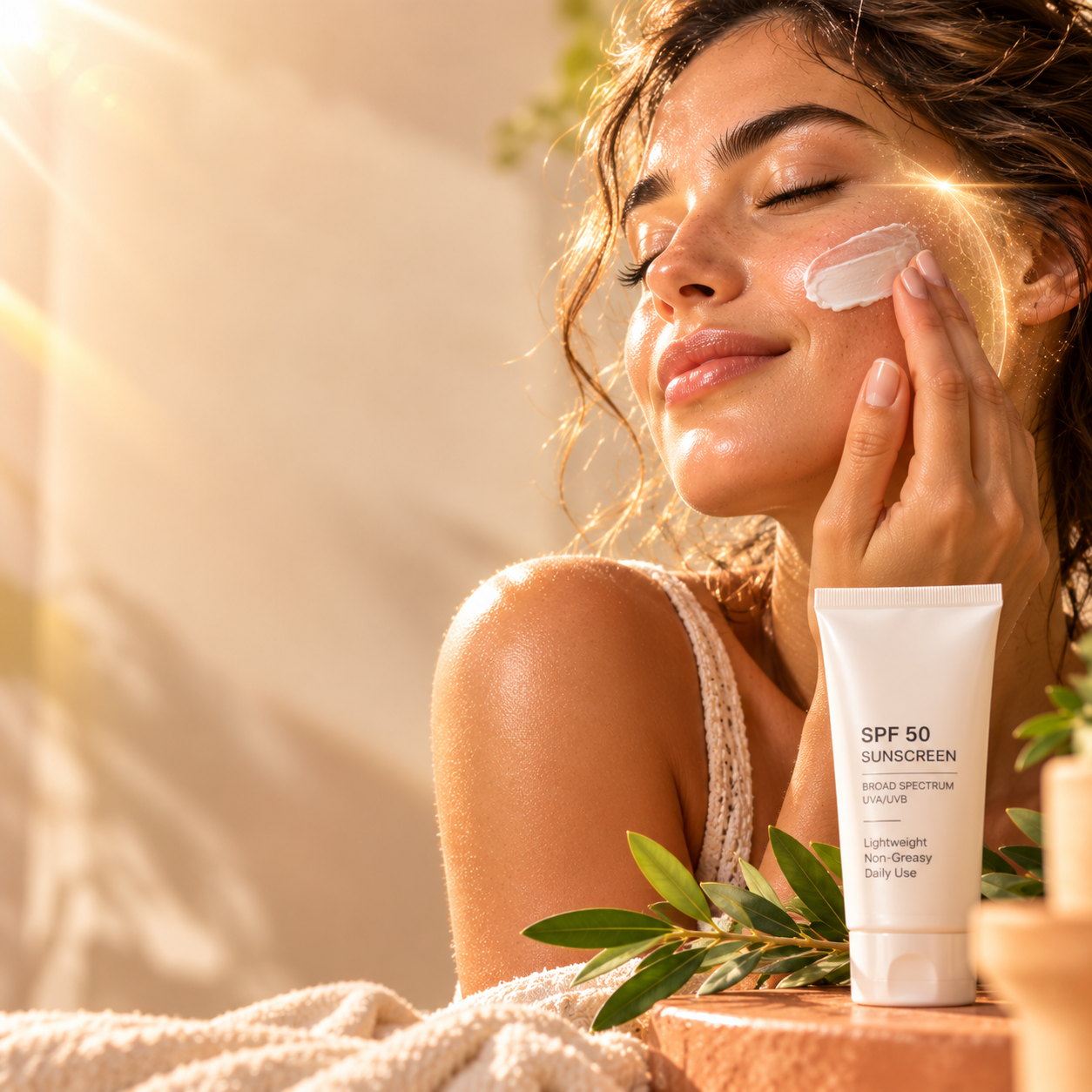
5. Broad-spectrum sunscreen
Important: Don’t use a DIY exfoliating mask on the same day as other strong exfoliating products or irritating actives (like retinoids or strong acids). The AAD recommends avoiding redundant active ingredients in masks to prevent over-exfoliation and irritation.
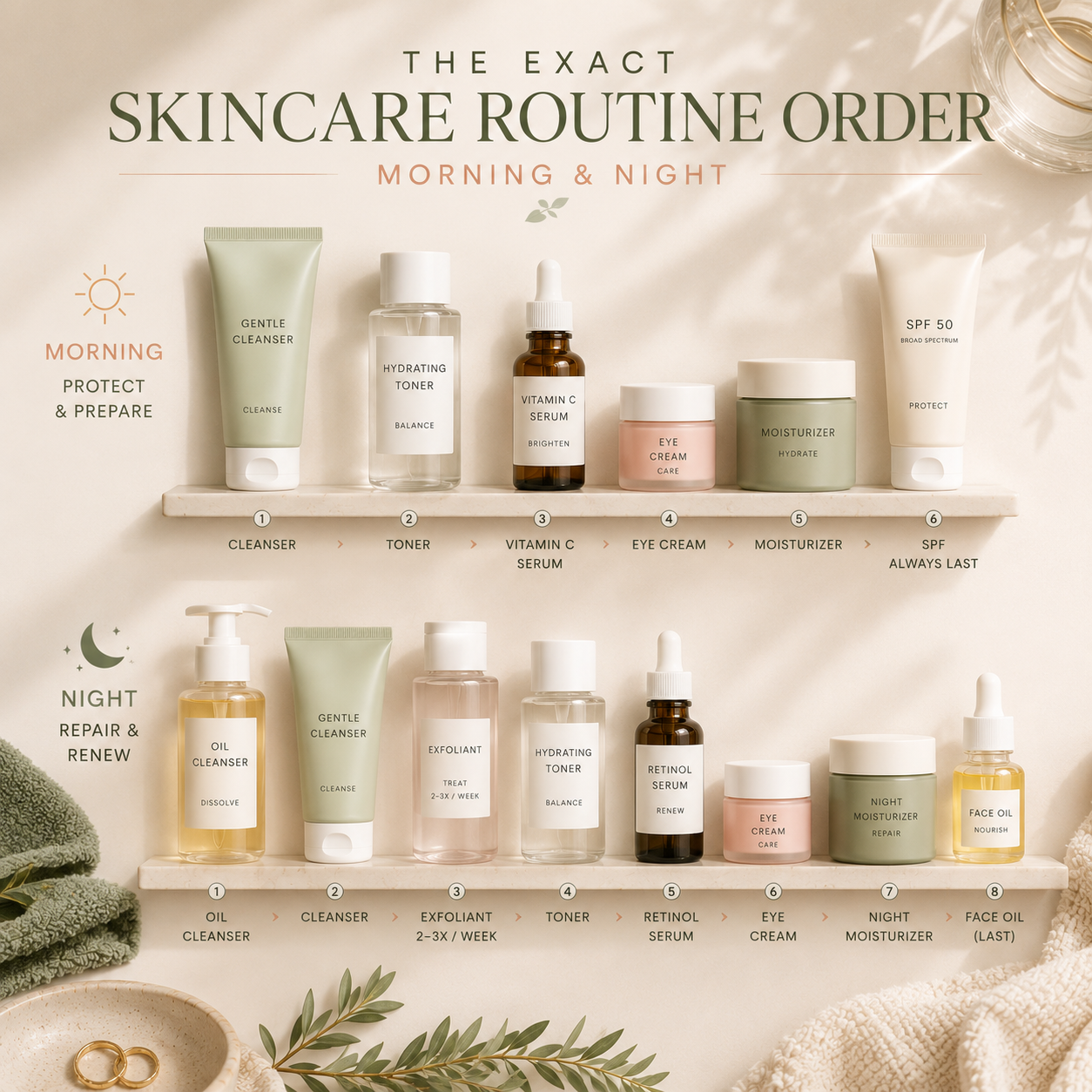
For a full breakdown of how to layer your products, see our Skincare Routine Order Guide.
Who Should Skip DIY Face Masks?
Consider skipping DIY masks if you:
- Have broken or irritated skin
- Have a current rash or flare-up
- Have recently had a cosmetic procedure
- Know you’re sensitive to one of the ingredients
- Experience burning or itching from the mask
- Are already using several exfoliating products
A DIY mask isn’t a treatment for acne, eczema, rosacea, or other skin conditions. Facial masks can complement skincare, but they aren’t a replacement for medical treatment. If you’re looking for evidence-based solutions, check out our Skincare Ingredients Guide.
How Quickly Will You See Results?
Don’t expect a homemade beetroot mask to transform your skin in a few weeks.
You may notice immediately after rinsing:
- Skin feels temporarily softer
- Skin looks fresh or slightly brighter
- A temporary rosy tint may remain from the beetroot pigment
Those effects don’t necessarily mean that the mask has changed your underlying skin pigmentation or collagen. For longer-term improvements in uneven tone, texture, acne, or pigmentation, consistent skincare with proven ingredients and daily sun protection is much more reliable than relying on DIY masks.
Beetroot Face Mask FAQ
Can beetroot remove dark spots?
No. There is no established evidence that homemade beetroot masks fade dark spots. For hyperpigmentation, use proven skincare ingredients like Vitamin C, niacinamide, or retinoids, and always wear sunscreen.
Can beetroot make your skin fairer?
No. Beetroot may temporarily leave a pink or rosy tint, but it does not bleach, whiten, or permanently lighten your natural skin tone. For a more even-looking complexion, focus on sun protection and evidence-based skincare rather than skin-lightening claims.
How often should you use a beetroot face mask?
Start with once a week. Stop immediately if you experience dryness or irritation.
Can I use beetroot on sensitive skin?
If you have sensitive or reactive skin, it may be better to skip DIY beetroot masks and choose a fragrance-free, formulated product instead.
Does beetroot help with acne?
There is no clinical evidence that beetroot treats acne. DIY masks are not a replacement for evidence-based acne treatments.
Can I use beetroot juice directly on my face?
It’s better not to apply concentrated beetroot juice directly to your face. If you choose to try a beetroot DIY mask, dilute it within a simple recipe and patch-test first.
Can beetroot stain your skin?
Yes, the natural pigments (betalains) can leave a temporary pinkish stain on the skin, especially if left on for too long. This usually washes off after a few rinses.
Can I leave a beetroot mask on overnight?
No. Leaving DIY masks on overnight increases the risk of irritation and bacterial contamination. Wash it off after 15-20 minutes.
Should I use sunscreen after a beetroot face mask?
If your mask contains exfoliating ingredients, protect your skin with broad-spectrum sunscreen during the day. Sunscreen is also essential for preventing and worsening hyperpigmentation.
Save This Beetroot Face Mask Guide
Save this guide before your next skincare day.
Three beetroot masks, three different skin goals—and everything you need to know before trying them.
📌 Glow: Beetroot + aloe
📌 Oil control: Beetroot + clay
📌 Hydration: Beetroot + yogurt + honey
Final Thoughts
The viral beetroot glow mask is a fun, colorful, and affordable way to pamper your skin at home. It can temporarily leave your skin looking fresh and feeling soft. However, it is not a miracle treatment for glass skin, dark spots, or acne.
Enjoy the ritual, but pair it with realistic expectations and a solid, sunscreen-forward skincare routine.
Sources / References:
- American Academy of Dermatology (AAD) – How to test skin care products
- American Academy of Dermatology (AAD) – Do facial masks work, and should I add one to my skin care routine?
- U.S. Food and Drug Administration (FDA) – Homemade Cosmetics: Fact Sheet