A spine tattoo is the only placement that turns your body into a single continuous line.
Thank you for reading this post, don’t forget to subscribe!That’s the whole appeal — and the whole problem. Because it’s one long axis, a design that works in isolation on a forearm can collapse down your back, and a design that looks perfect on paper can fight the way you actually move.
Below are 27 real spine and back pieces, sorted into the six style families people are actually searching for. For each one you’ll see what the design is doing structurally — so you can brief an artist instead of handing over a screenshot.
Why the spine works differently from anywhere else on the body
The back gives you something no other placement does: verticality.
Your spine is a built-in centreline. Designs that flow down it look intentional. Designs that sit across it look like they’re fighting the body iglatattoo.
There’s a practical bonus too. Skin on the back stretches less over time than on an arm or stomach, which is part of why delicate linework holds its shape there longer Grisáceos.
And then there’s the reveal factor — hidden under a t-shirt, unforgettable in a backless dress.
1. Script and lettering down the spine
The single most-searched spine category, full stop — Pinterest reports 9,000+ searches for script spine tattoo alone Pinterest.
The reason is structural: a phrase gives the artist a natural ruler to work against. No filler, no background, no shading decisions — just typography following your vertebrae.
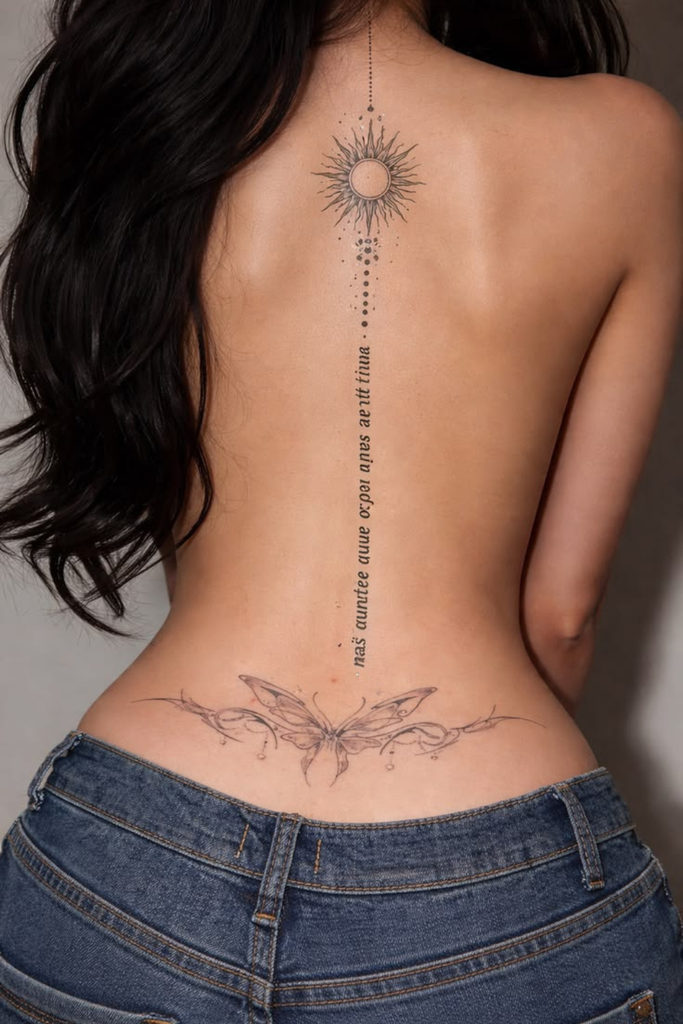
This is the blueprint: a sunburst at the top of the shoulder blades, a dotted taper, a clean column of script through the mid-spine, and a butterfly landing at the lumbar. Three visual anchors, one line. Note how the sun’s rays point outward while everything below points down — that’s what stops a vertical design from reading as a stripe.
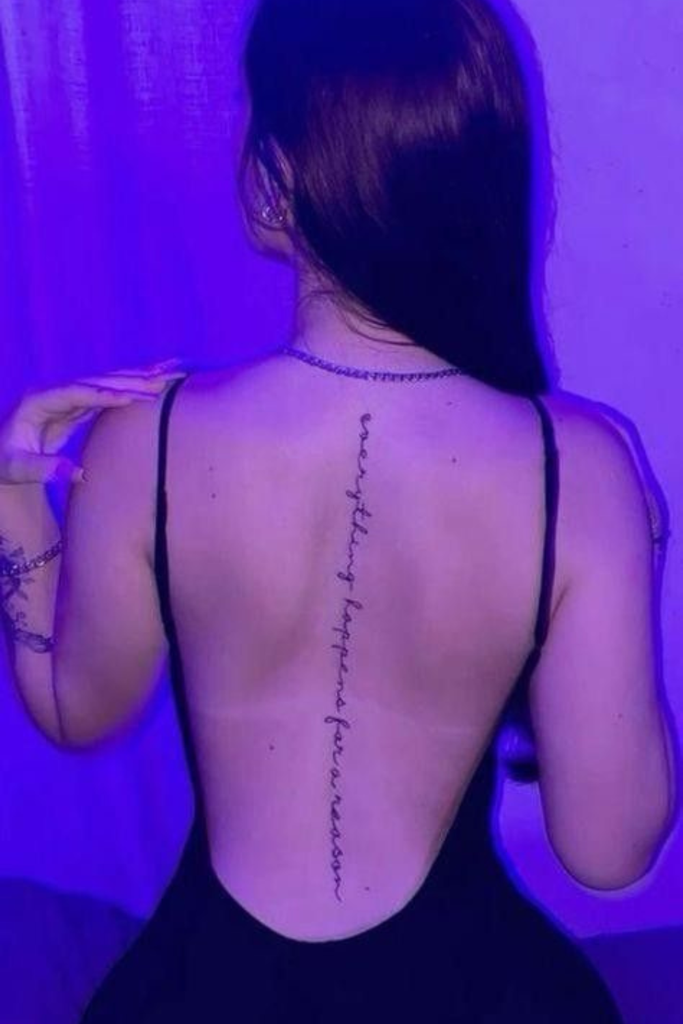
A pure single-column quote. When the lettering is the entire design, size discipline is everything: too large and it wraps around your ribs as you move, too small and the letters close up within a year Allure.
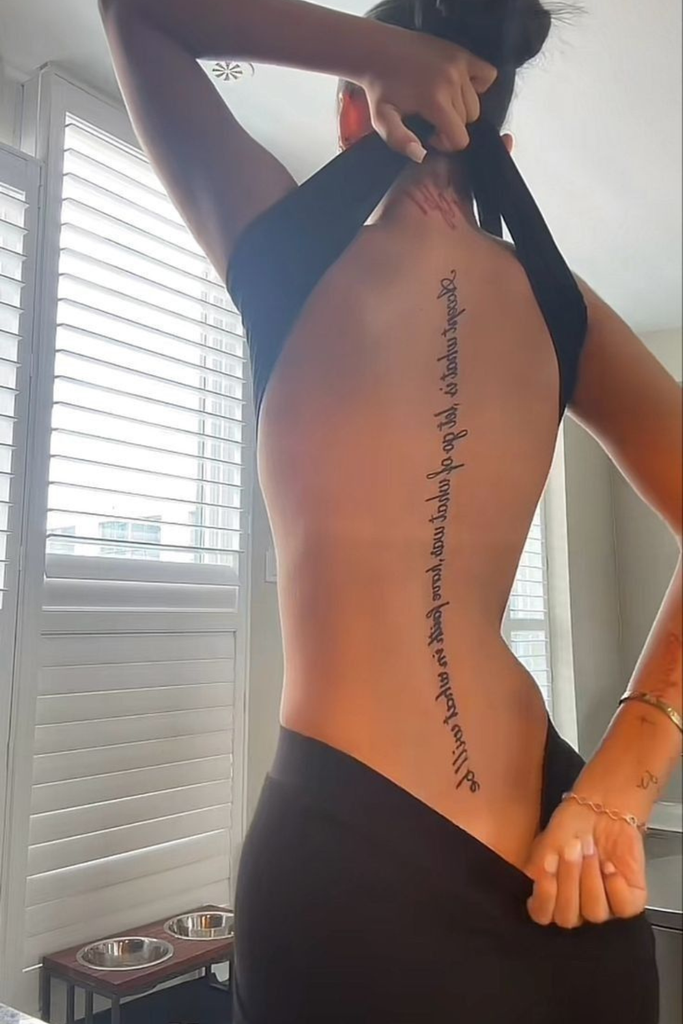
This one solves a problem most people don’t think about until the stencil is on: the spine isn’t straight, it’s an S-curve. Good spine lettering is designed in an arc, not a ruler line, so it reads as flowing with your posture instead of contradicting it.
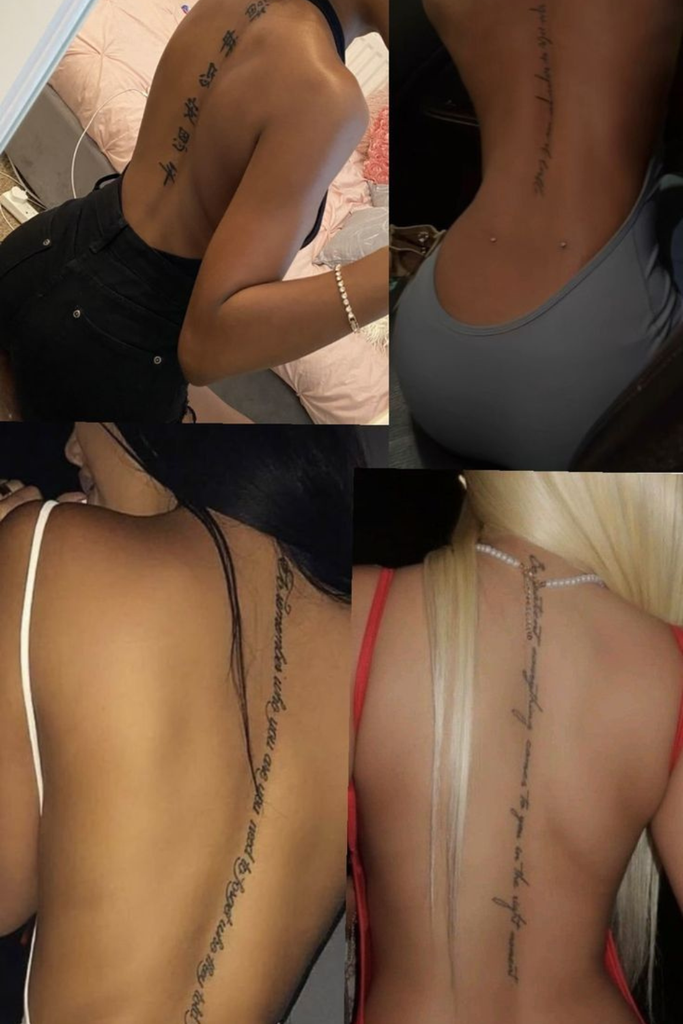
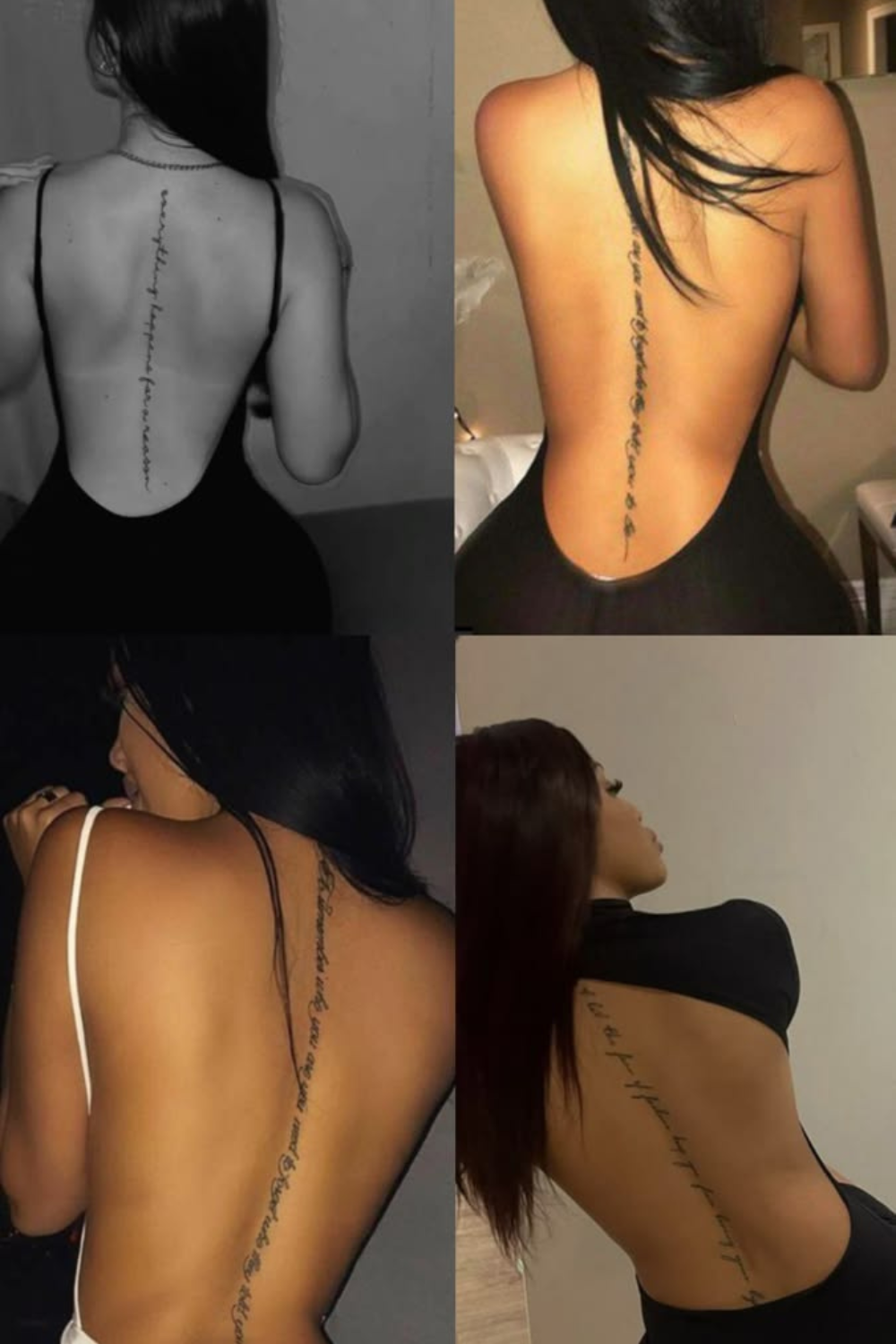
Four treatments of the same idea, and a useful comparison. Left-facing, right-facing, and laddered (stacked words) all appear here — the debate Reddit keeps having Reddit. The rule of thumb: readable when your head turns left means the text should face left, or choose stacked words to sidestep the question entirely.
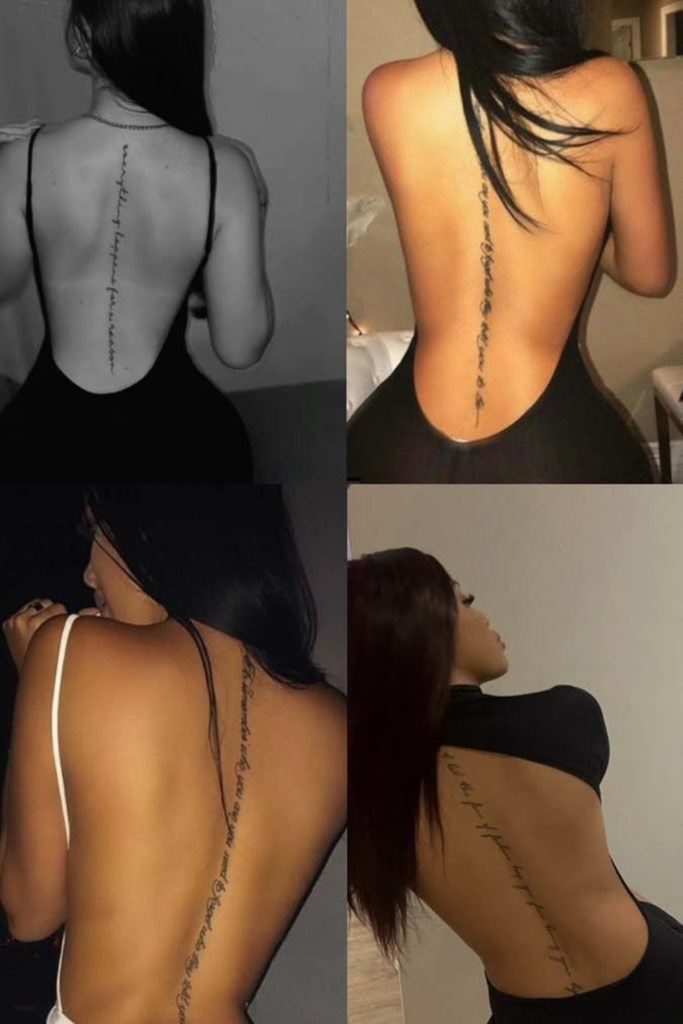
Four real-world versions in backless and scoop-back clothing. Look at how the longest quotes are set on the thinnest part of the back — the quote shrinks the waist rather than widening it.
Best for: a first tattoo, a memorial, a sentence you’ll never get bored of.
Risk: unreadable lettering is the most common tattoo regret there is. Get the spelling and the font drawn by someone who does lettering, not a generalist.
2. Botanical fine line: flowers as architecture
Floral is the most requested spine design among working artists, and it’s not purely aesthetic — stems and vines are already vertical, so they do the structural work for free iglatattoo.
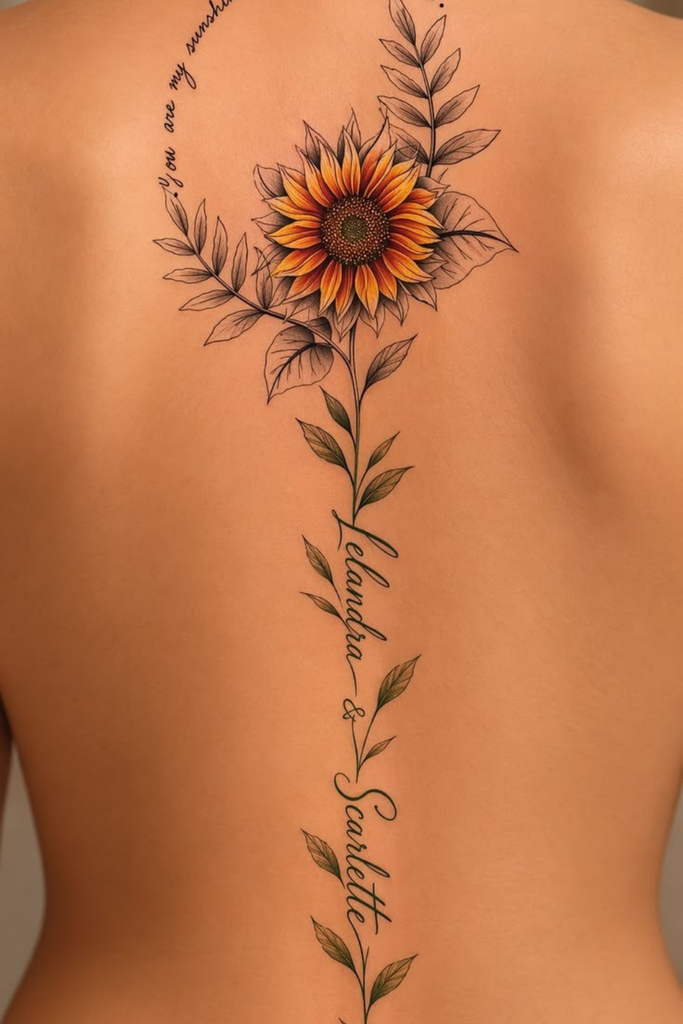
Colour here is used sparingly and correctly: gold petals as the focal point, everything else in grey so the eye has somewhere to rest. The arch of text at the top frames the bloom instead of competing with it — a trick worth stealing for any flower-plus-quote design.
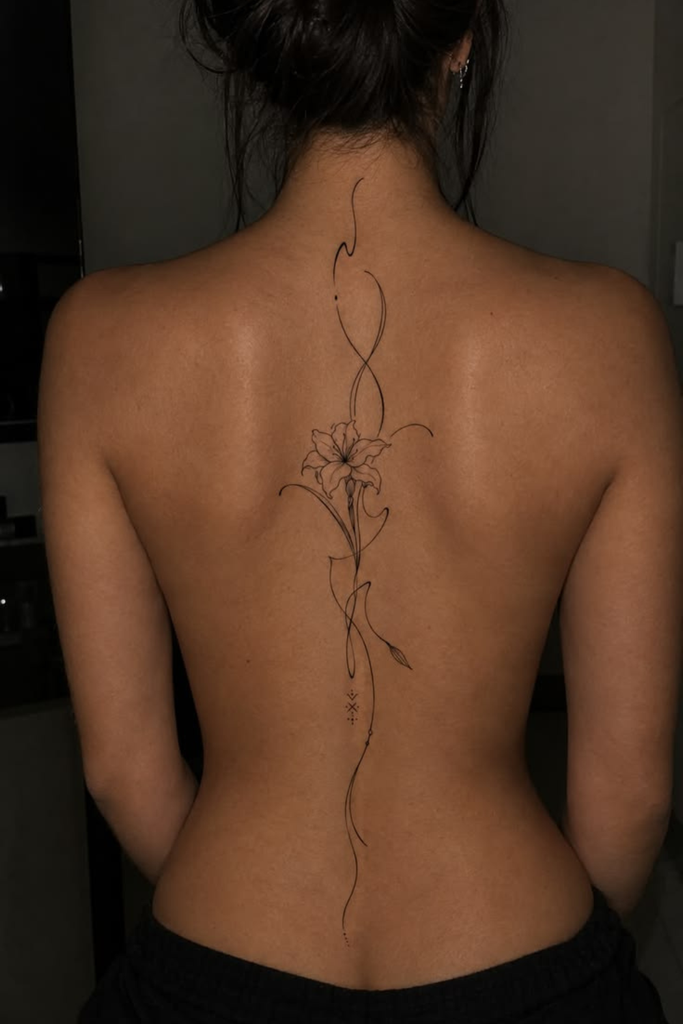
The most minimal version of the family, and arguably the most durable. A lily, a single twisting stem, and a few dots to indicate movement. Nothing in this design requires heavy saturation, which means less chance of the ink spreading into a blur later.
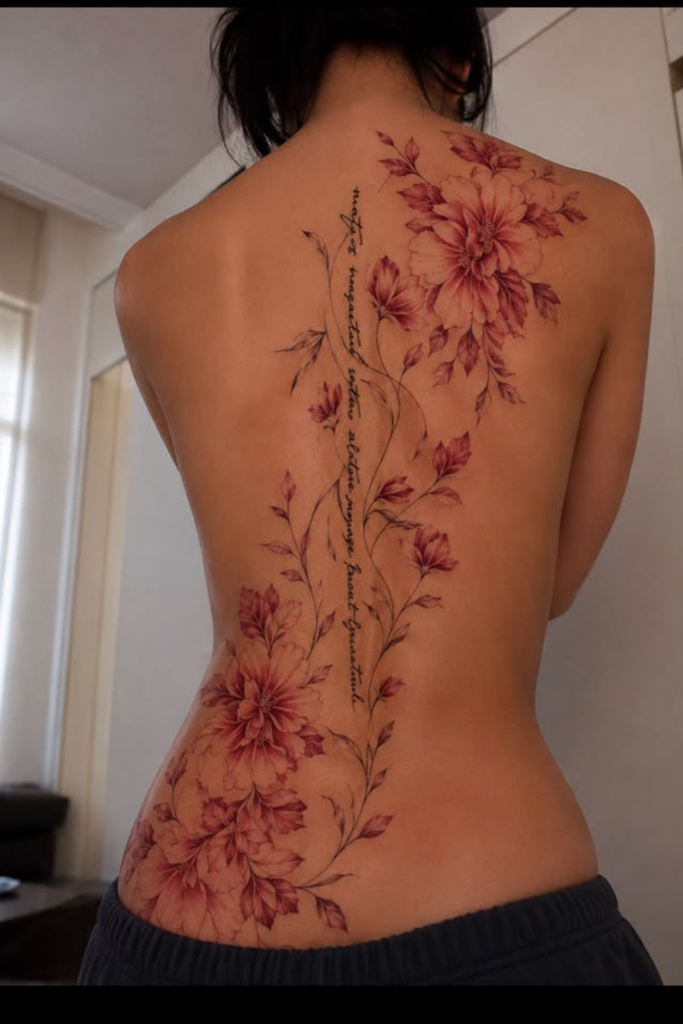
Colour-drive florals like this are the current 2026 direction for back pieces — and the reason it works is the asymmetry. The blooms cluster off-centre, the vine crosses the spine, the script cuts straight through. Symmetry is optional; balance is not.
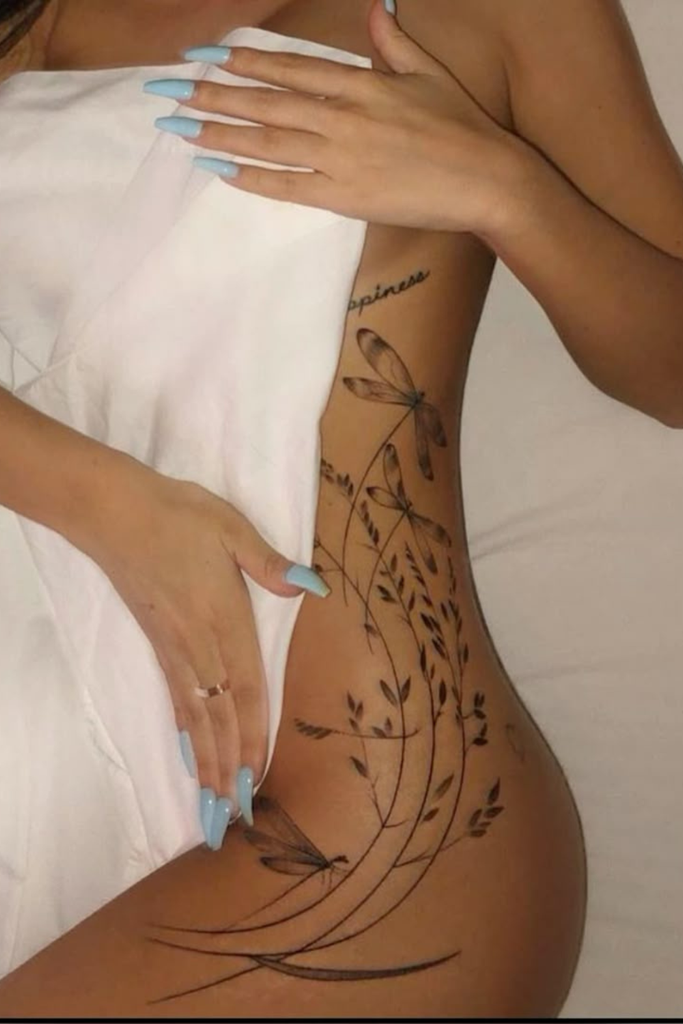
Not on the spine at all — and included on purpose. Ribcage-to-hip is the alternative “vertical” placement, and it flatters the waist more than a spine piece does. The grass stalks act like a stem for the tattoo, giving the dragonflies something to climb.
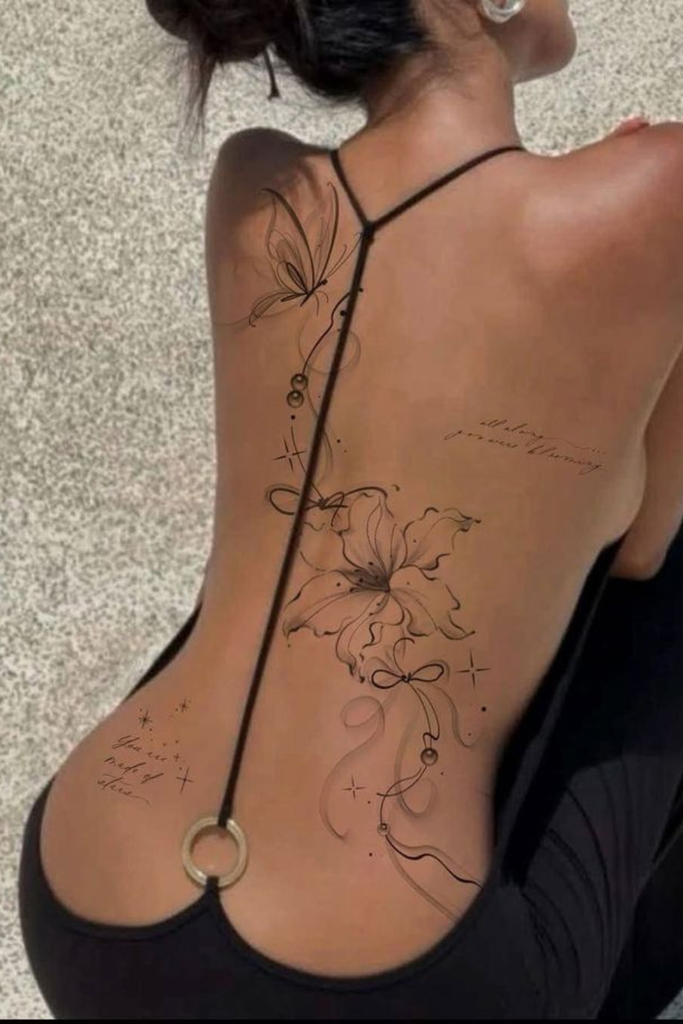
The coquette treatment: butterfly at the top, lily at the bottom, ribbons and scattered stars between. What makes it work rather than look cluttered is hierarchy — one large bloom, one butterfly, everything else at a fraction of the size.
Best for: people who want softness and detail rather than impact.
Risk: the more single-needle detail you pack in, the more it softens as the years go by iglatattoo. Design for the ink that will still be there in 2045, not for the photo on day one.
3. Celestial, ornamental and sacred geometry
This is the family that leans hardest on the spine’s symmetry. When your design has a central axis, the body supplies half the composition for free.
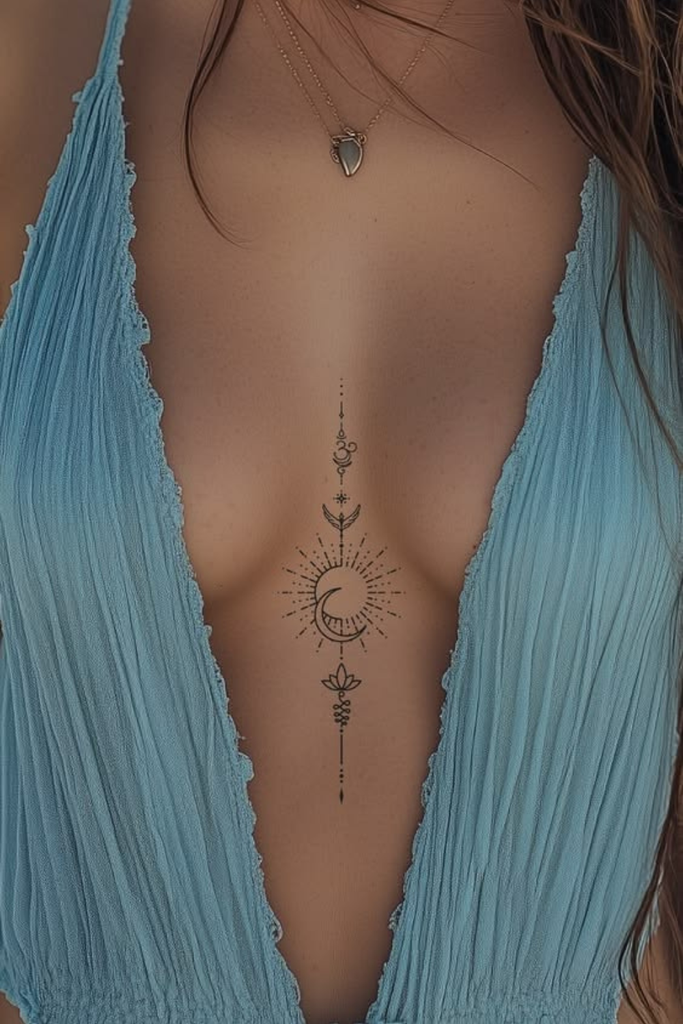
Technically a sternum piece rather than a spine one, but it’s the same logic and worth studying: an unalome, om, crescent, sunburst and lotus stacked on one run. Each symbol is separated by fine geometry so the eye reads it as a journey rather than a pile.
The unalome itself is the most requested spine symbol in this category — the spiral representing the confusion of early life, straightening into clarity as the path continues toward enlightenment Tattoodo.
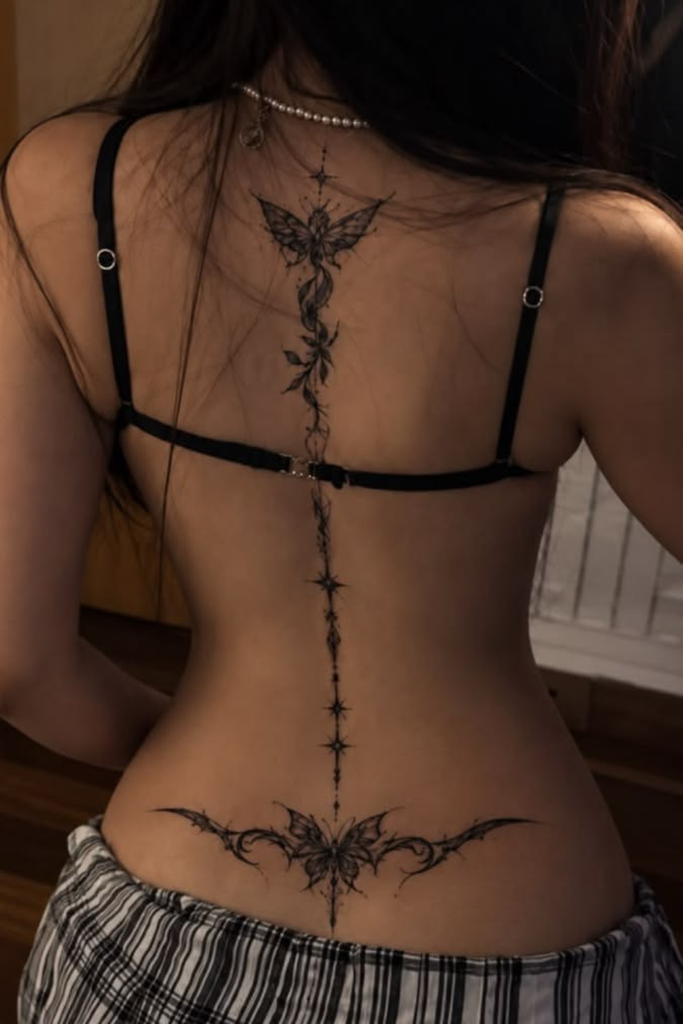
The strongest composition in the whole set. A moth at the nape, a chain of four-pointed stars down the vertebrae, and a symmetrical butterfly anchored at the lumbar. It’s essentially typography built from symbols — a sentence written without letters, and it never needs re-reading.
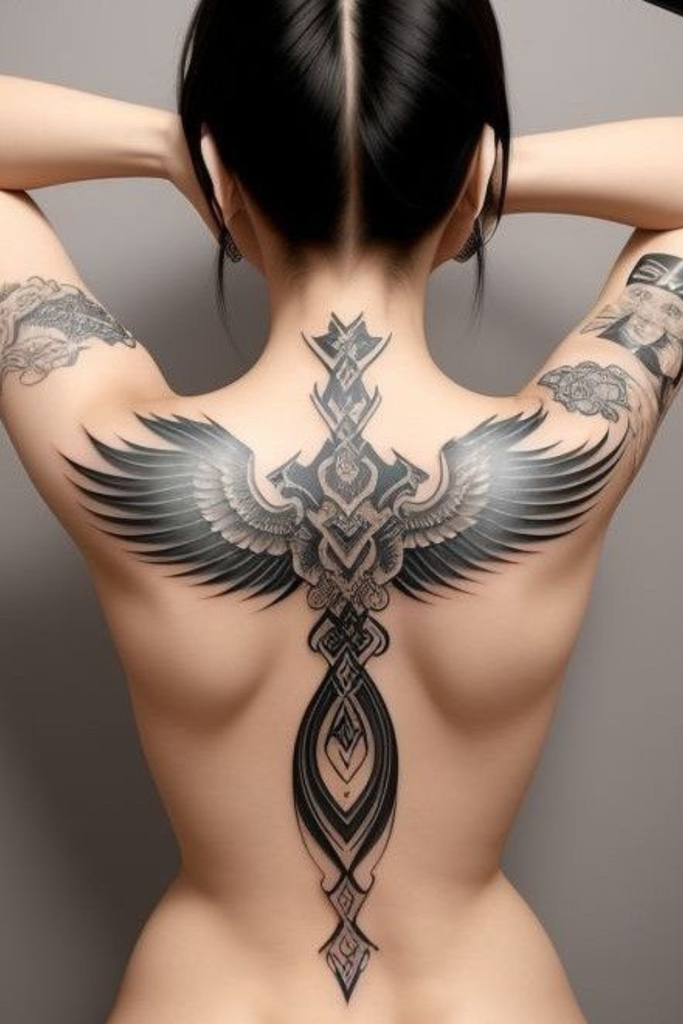
Ornamental geometry at shoulder-blade width. The wings spread horizontally to use the muscle, then everything collapses into a slim diamond down the spine. This is how you take up the whole upper back without turning it into a mural.
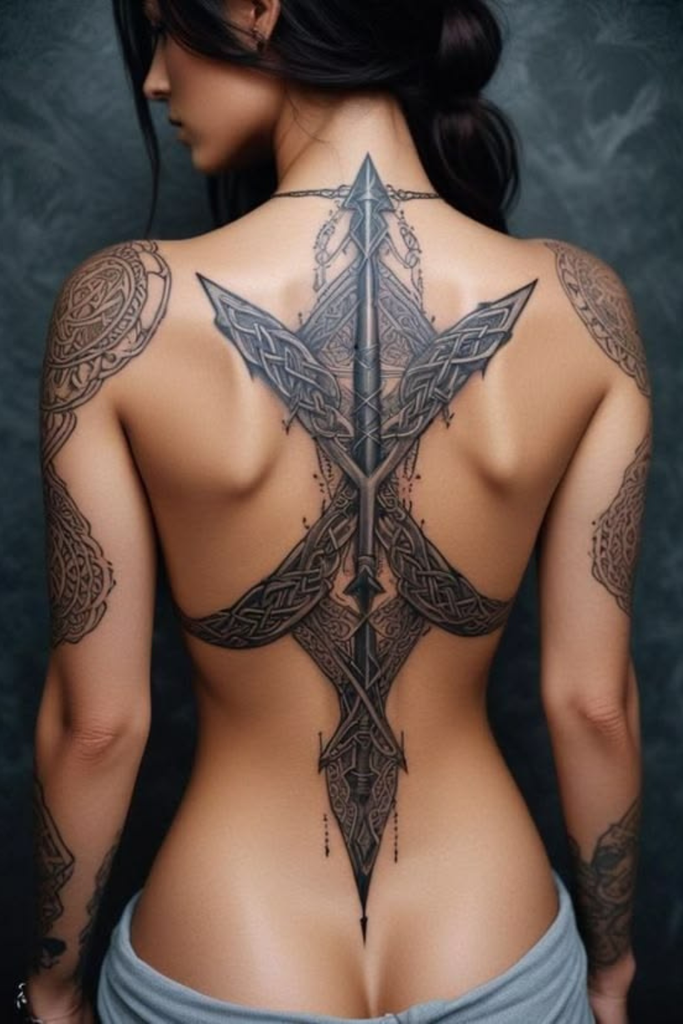
Knotwork sword, mirrored arm bands, centre-back placement. Worth noting the arm pieces: a large back design usually looks unfinished alone, so plan the sleeve continuation at the same time as the back brief.
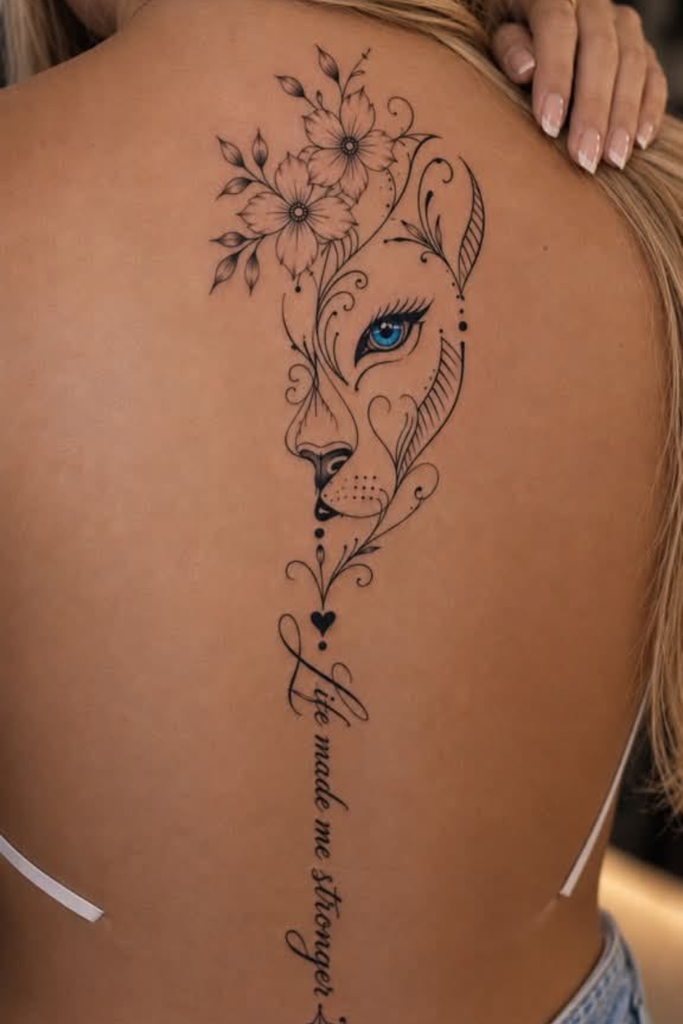
A single colour accent — that blue iris — turns an otherwise monochrome ornament into a focal point. See also how the filigree doesn’t just decorate the lioness; it descends, connecting the animal to the text below it.
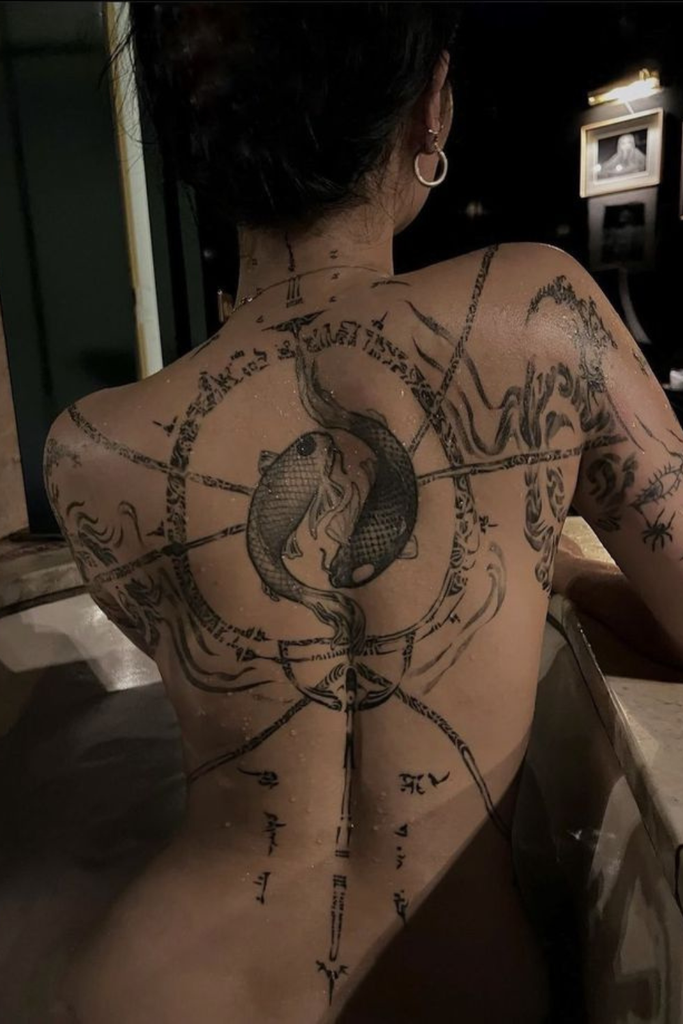
The most ambitious version: koi in yin-yang formation inside a celestial wheel, with compass rays extending to the shoulders. This is a multi-session, full-back commitment, and the wheel is what holds it together — without that circle, the surrounding runes would read as noise.
Best for: people who want meaning encoded rather than illustrated.
Risk: ornamental designs demand precision. A wobbling circle or uneven crescent is instantly visible; this is not the family to bargain-hunt on.
4. Mythical creatures at full-back scale
Dragons and phoenixes dominate the large-format searches — and both carry the same emotional territory: overcoming something.
Phoenix symbolism centres on rebirth, resurrection and renewal — rising above what burned you inkppl. Dragon symbolism leans toward strength, power, independence and personal growth Tuko, Lemon8.
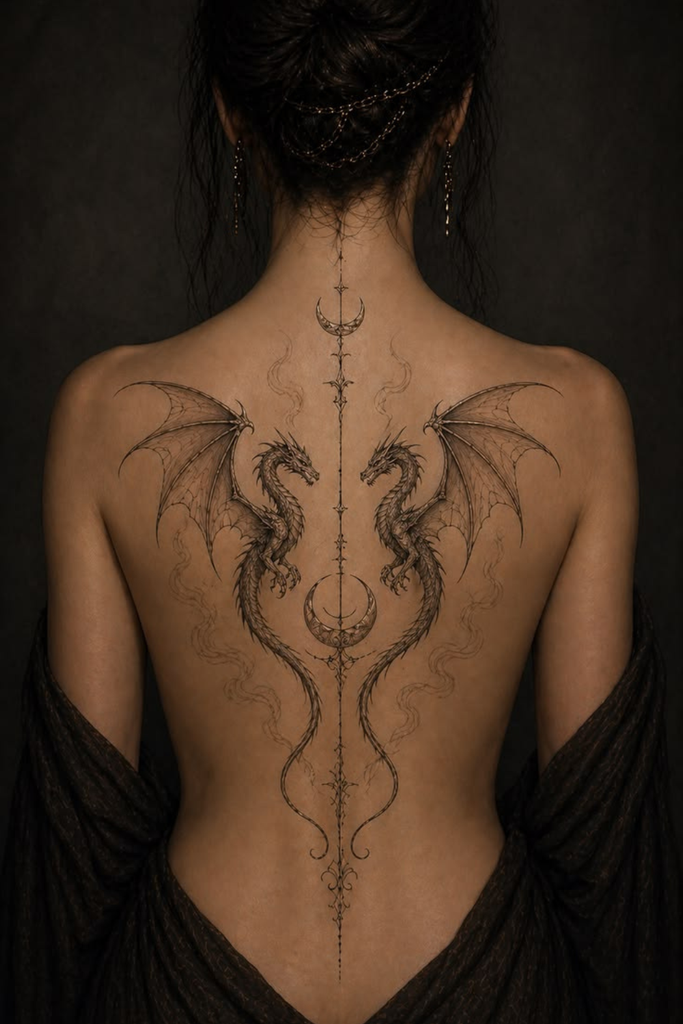
Two mirrored dragons facing a central ornamental axis, with crescent moons bookending the composition. The genius here is that the dragons are the vertical form — their tails and smoke trails do the job that a vine would do in a floral piece. Mirroring two creatures is also the cheapest way to make a large back design look deliberate rather than sprawling.
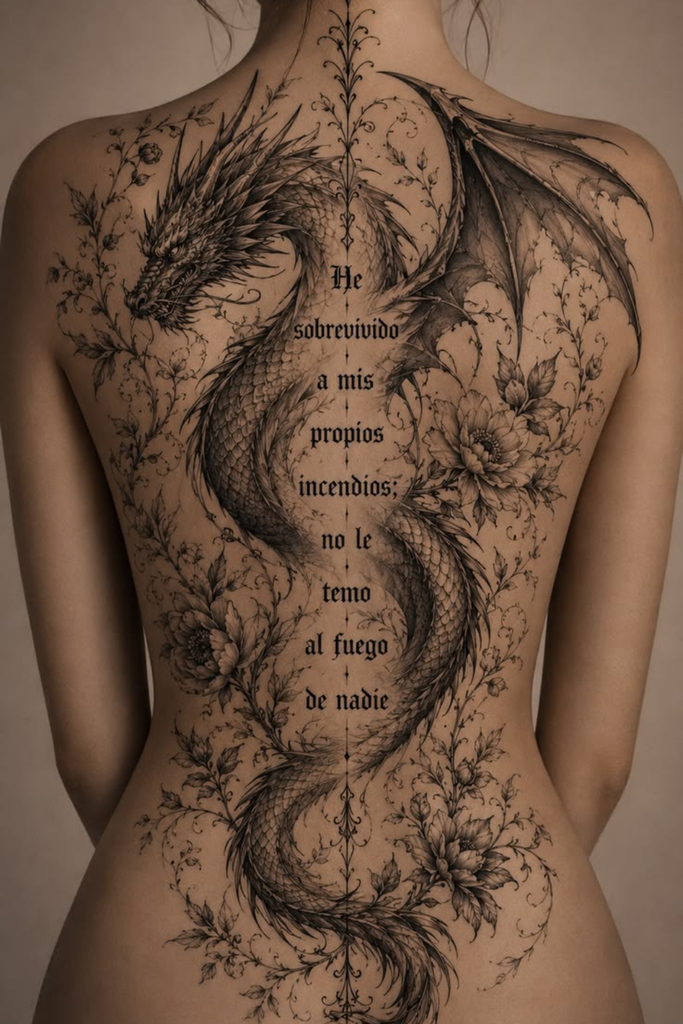
Engraving-style blackwork with blackletter text: “He sobrevivido a mis propios incendios; no le temo al fuego de nadie.” Full nape-to-sacrum coverage. Note the botanical border — the flowers aren’t decoration, they’re what keeps a very dark piece from becoming a black rectangle.
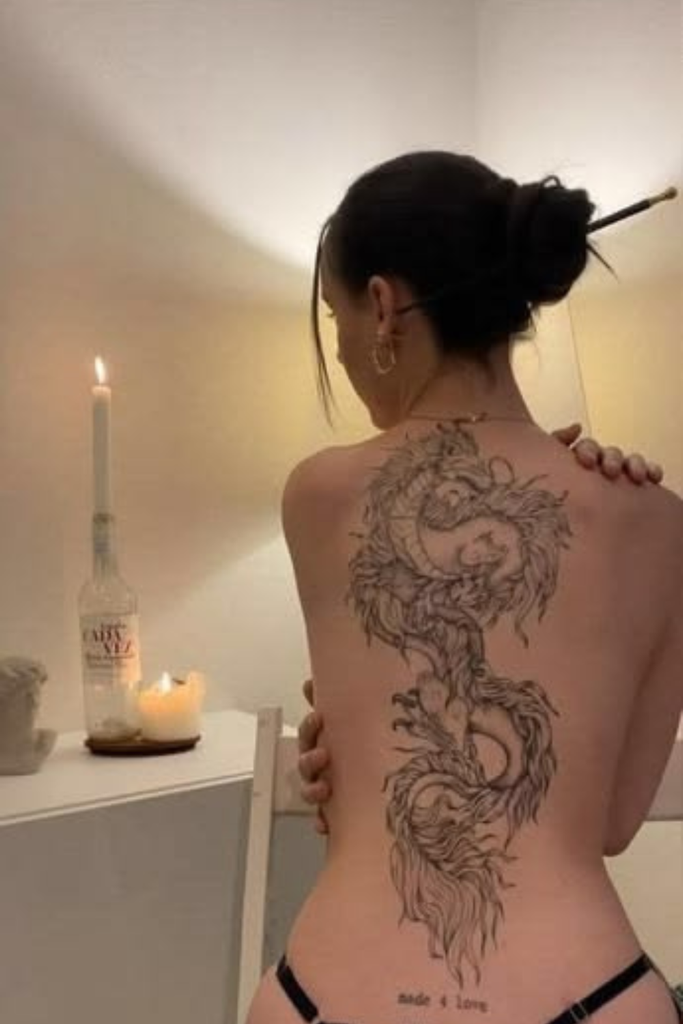
The lightest possible take on the theme. A single sinuous Eastern dragon with no background, no shading block, no framing — just the animal and negative space. Proof that “dragon tattoo” doesn’t automatically mean “heavy”.
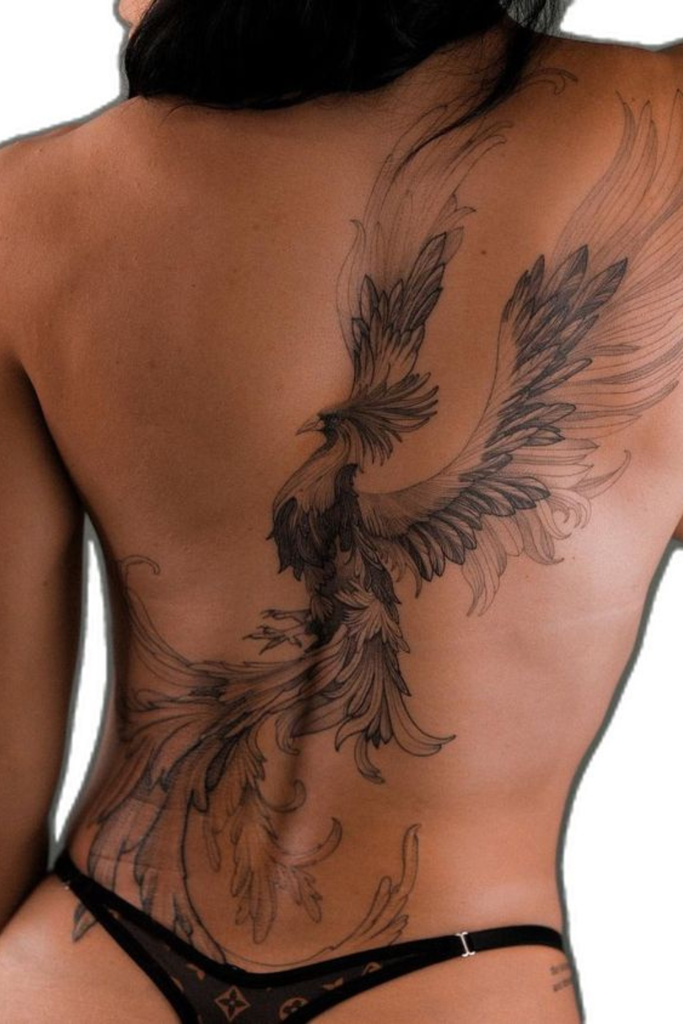
Sketch-style phoenix, wings open across the full back, tail feathers melting into swirls at the waist. When the bird’s wingspan defines your silhouette, the design needs to be drafted on your body, not scaled up from an A4 drawing.
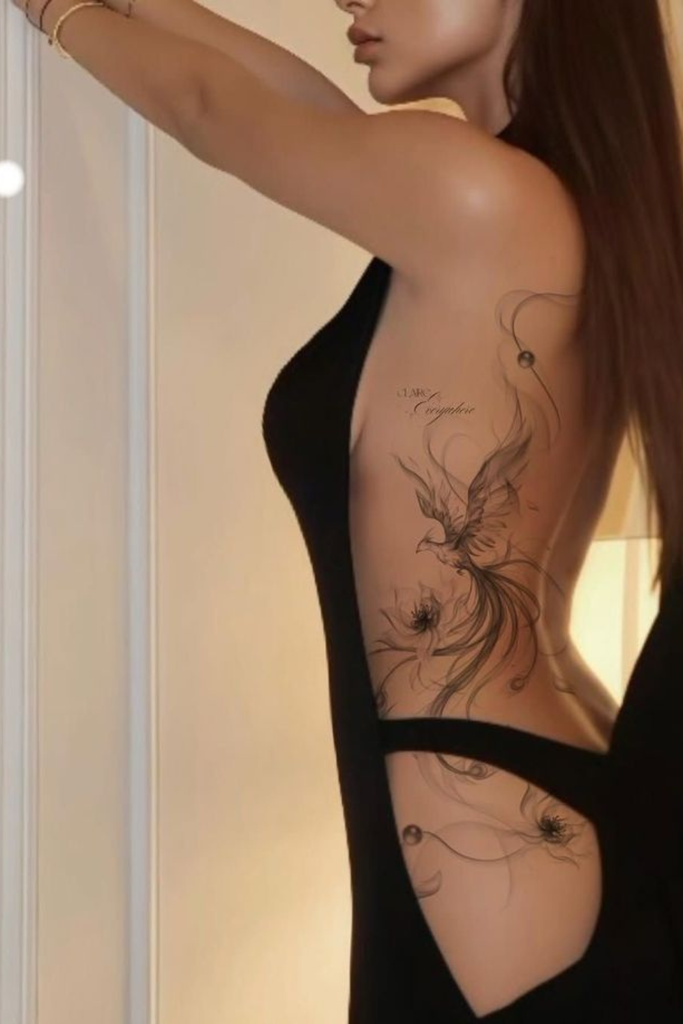
The same subject, a fraction of the weight. Ribcage-to-hip phoenix with lotus blossoms and floating pearl accents. If you love the symbolism but not the mass, this is the version to show an artist.
Best for: a statement piece, a significant life marker, a full-back budget.
Risk: scale. These are multi-session, and a creature that’s too small for the space will look cramped forever.
5. Dark feminine and gothic blackwork
The fastest-growing style in the set, and the one 2026 trend coverage keeps naming alongside fine line botanicals Instagram.
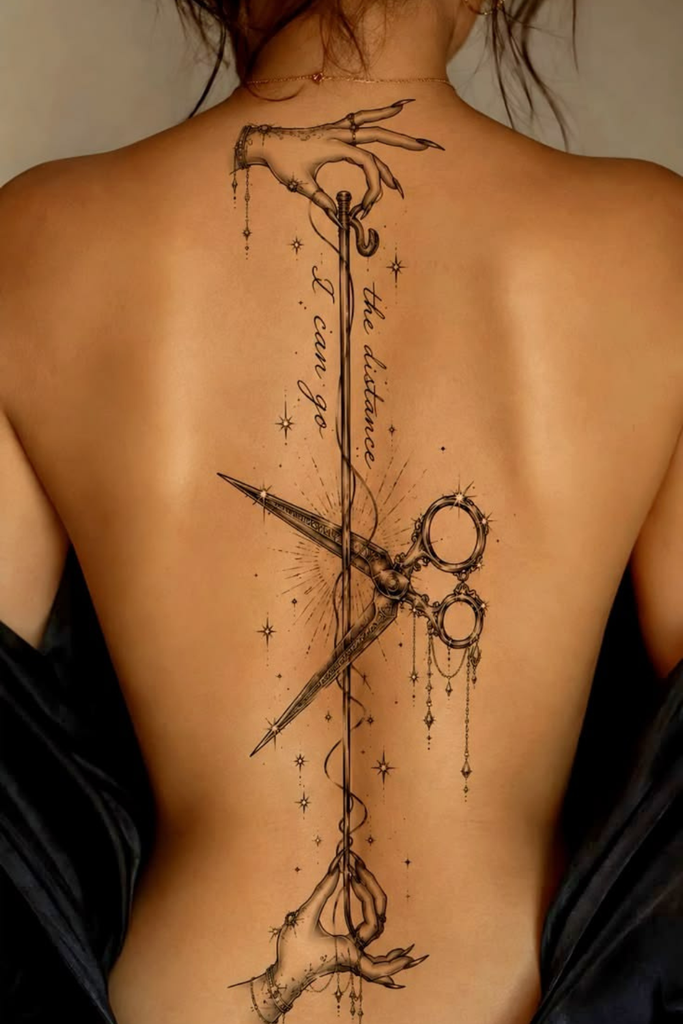
Two clawed, bejewelled hands pinning an antique pair of scissors with a needle, flanked by “I can go the distance.” The whole thing hangs on one straight line — the pin — which is what makes an ornate, busy, highly detailed design still read cleanly from across a room.
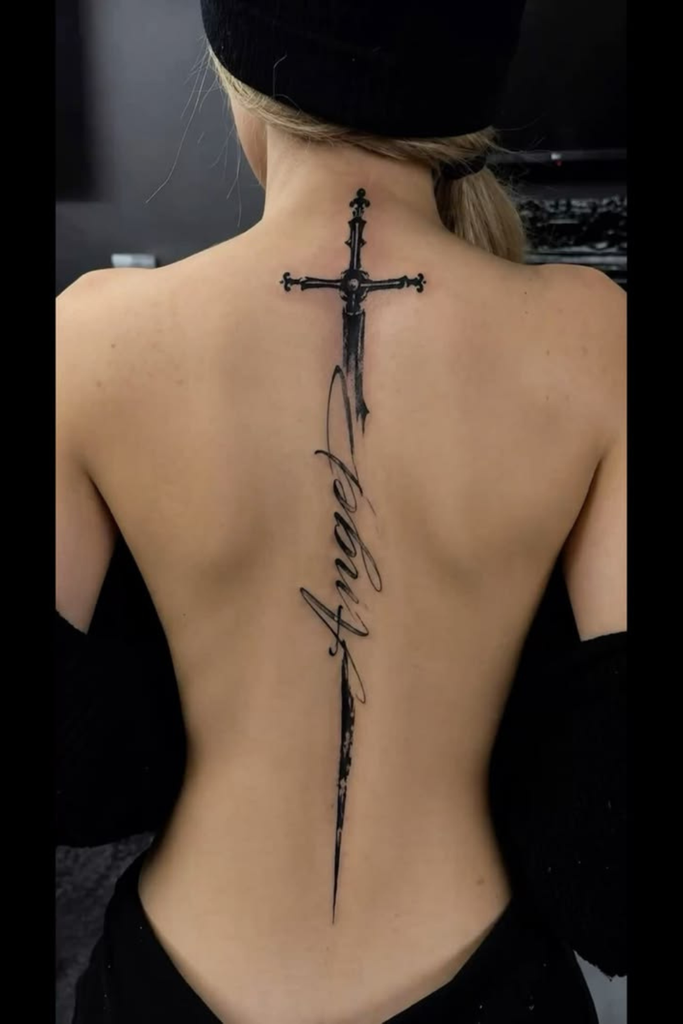
The most technically clever idea here: the sword’s blade becomes the word, tapering into a dagger point. Lettering and symbol in one continuous gesture, hilt at the nape, tip at the lumbar. If you’ve been stuck between “a quote” and “an image”, this is your answer.
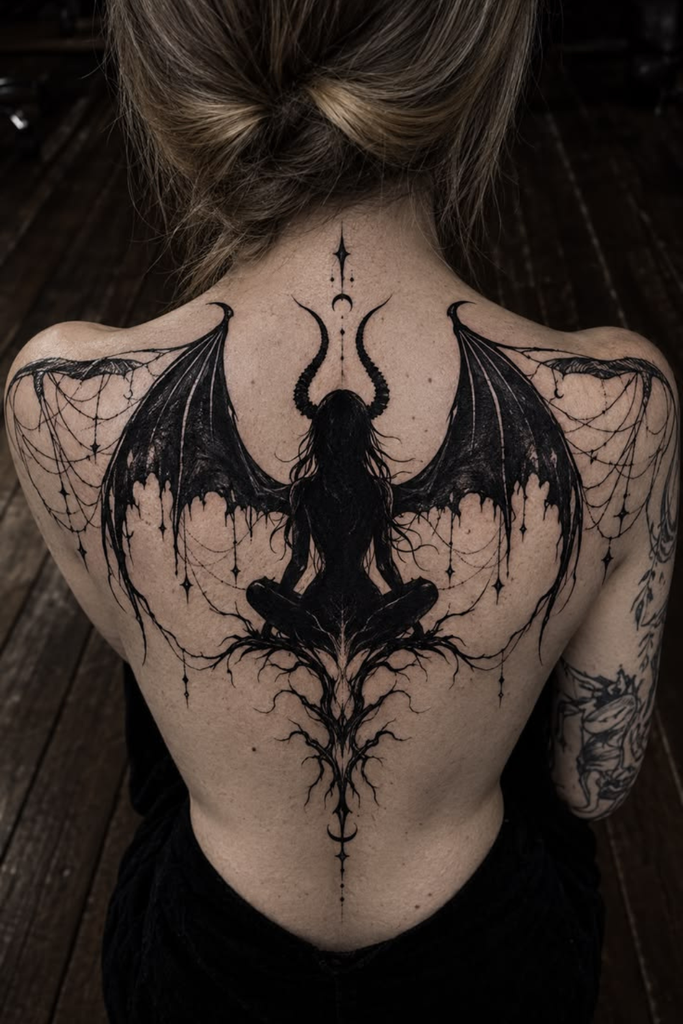
A horned figure in lotus position, wings spread across both shoulder blades, wrapped in beaded spiderwebs and ending in thorned roots along the spine. Occult, symmetrical, and deliberately unsettling — the “dark feminine” aesthetic at its most literal.
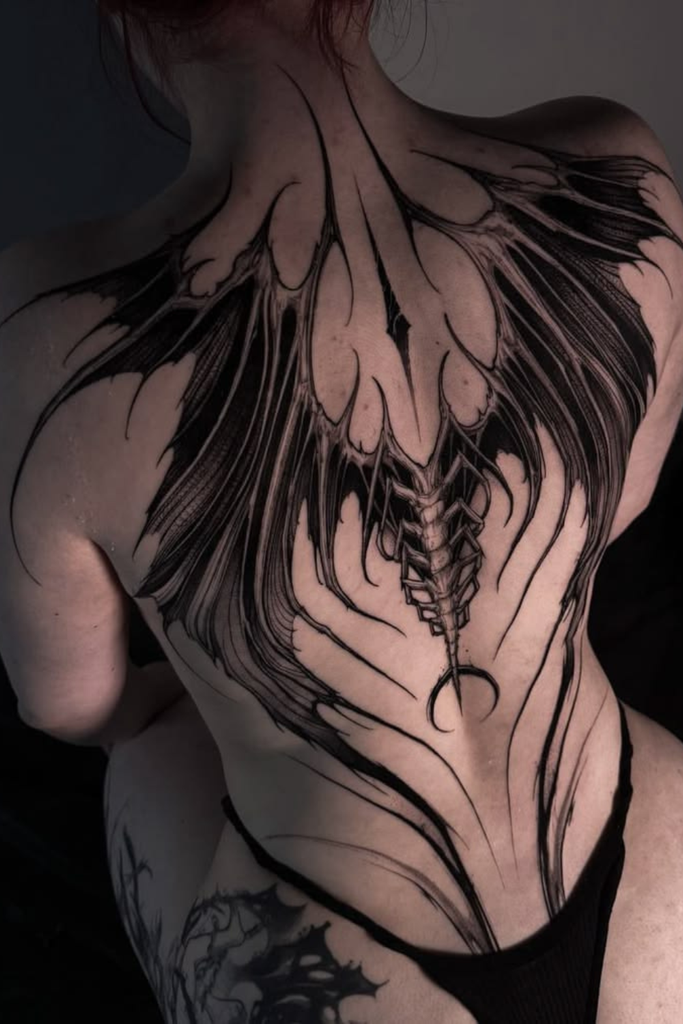
Skeletal bat-like wings fused into the neck and shoulders, an exposed vertebral structure rendered as the tattoo’s spine, and a hanging crescent. Body-horror as ornamentation — and a smart use of the placement, since the design mimics the anatomy it sits on.
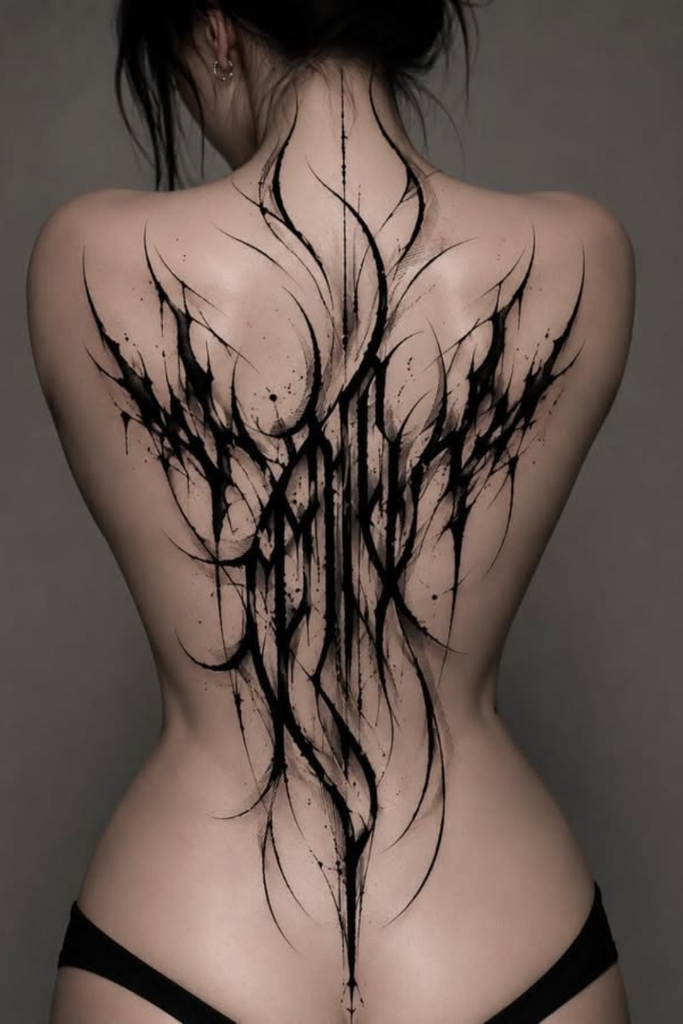
Abstract ink: thorn-like structures, radiating lines, deliberate splatter. No motif at all, just movement and contrast. The most forgiving style on this list to age — abstract blackwork doesn’t have to stay crisp to keep working.
Best for: contrast, coverage, a piece with real presence.
Risk: heavy saturation over bone. Healing is slower and touch-ups are more likely on black-filled areas.
6. Colour accents and Y2K patchwork
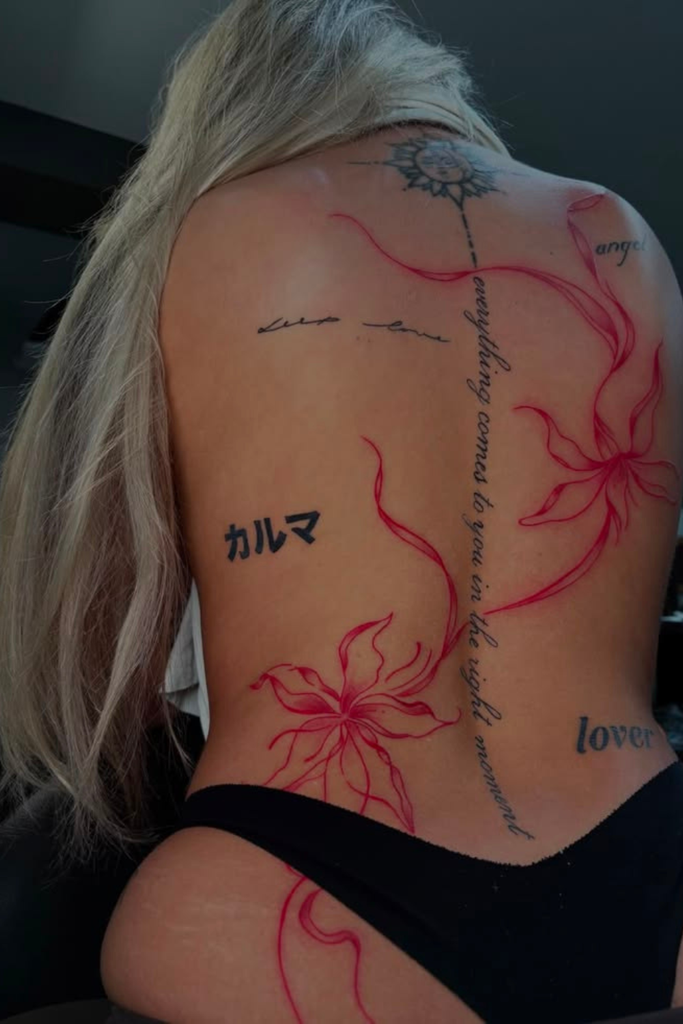
Red ribbons, red lilies, black script, katakana カルマ (karma), and small scattered words. This is the patchwork approach: several small tattoos placed around the spine rather than one continuous piece. It reads as a collection of moments instead of a single statement — easier to add to over years, harder to design all at once.
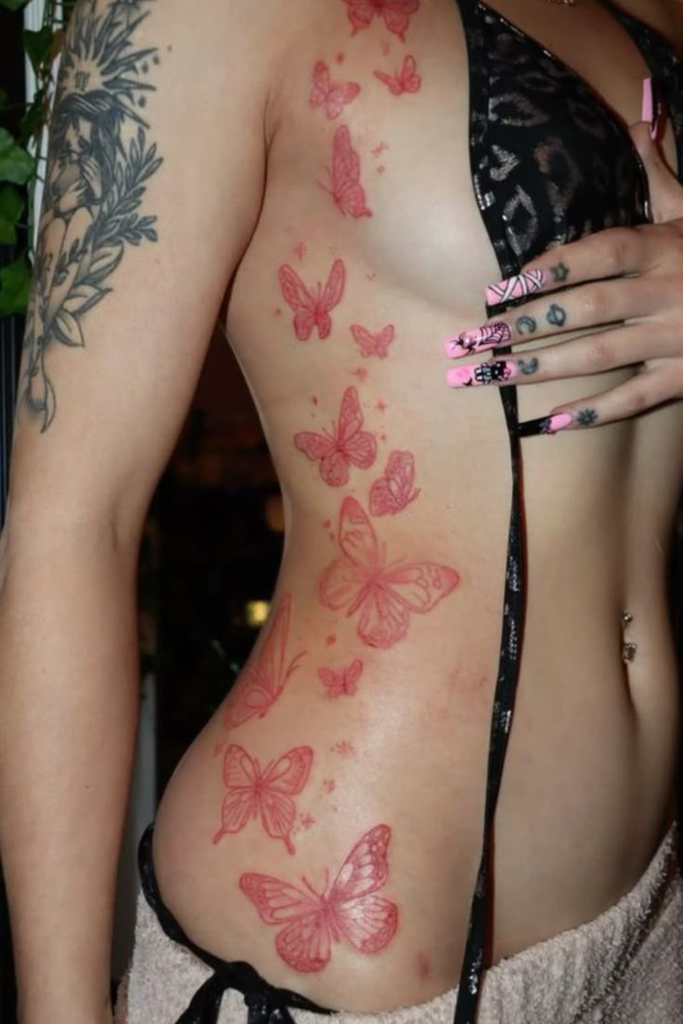
A swarm of red butterflies rising along the side of the body. Single-colour ink like this is the smartest way to get impact without black mass — and the fact that the butterflies are moving upward is what gives it energy.
Best for: people who want softness with colour, or plan to build over time.
Risk: single-colour ink (especially red) fades and needs refreshing faster than black.
Placement: which zone of the spine does what
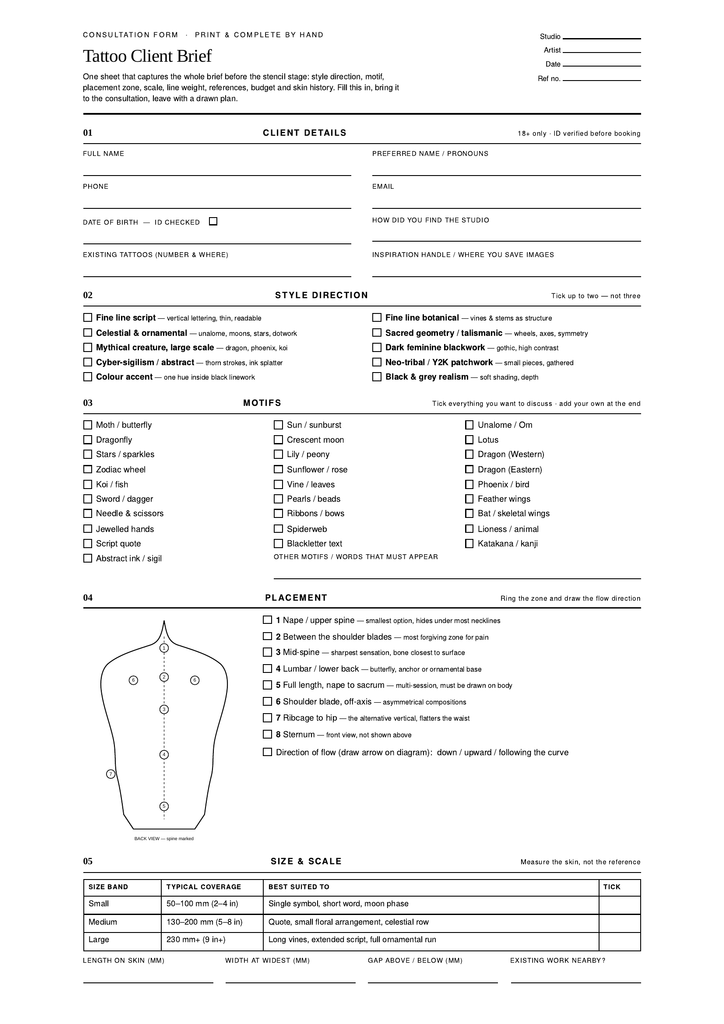
| Zone | Coverage | Best for | Real-world note |
|---|---|---|---|
| Nape / upper spine | 2–4 in | Small symbols, single words, dagger hilts, moths | Shortest option, hides under almost every top, peeks above a neckline Monolith |
| Between the shoulder blades | 5–8 in | Symmetrical ornaments, wings, mirrored creatures | Most forgiving zone for pain — more muscle cushioning here iglatattoo |
| Mid-spine | 5–9 in | Quotes, floral arrangements, celestial rows | Sharpest sensation; vertebrae sit closest to the surface |
| Lumbar / lower back | 3–6 in | Butterflies, ornamental anchors, small symbols | Back in fashion in 2026; visible in low-rise and backless cuts Facebook |
| Full length (nape to sacrum) | 9+ in | Long vines, extended script, full ornamental runs | Multi-session; needs to be drawn on your body, not scaled |
| Shoulder blade (off-axis) | varies | Offset designs, asymmetrical pieces | Allows an off-centre placement where the spine demands a central axis Encrevive |
Meaning cheat sheet
| Motif | What it usually carries |
|---|---|
| Butterfly | Transformation, freedom, rebirth — and the lower-back placement adds a note of resilience Instagram |
| Phoenix | Rebirth, renewal, rising above what burned you inkppl |
| Dragon | Strength, power, independence, personal growth Tuko |
| Unalome | Life’s journey — the spiral of struggle straightening into clarity Tattoodo |
| Sword / dagger | Resolve, protection, a boundary you drew yourself |
| Koi | Perseverance, transformation, swimming upstream |
| Flowers | Beauty, growth — and when they’re a birth flower, a specific person |
| Script | Whatever you decide it means, which is usually the point |
The honest practical part
Does a spine tattoo hurt?
Yes — it’s one of the more painful placements. The skin over the spine is thin, sits directly on bone, and carries a high concentration of nerve endings iglatattoo.
Where it hurts least: the upper spine between the shoulder blades, where muscle cushions the bone. Where it hurts most: mid and lower spine iglatattoo, and back work generally ranks moderate-to-high on pain-scale guides Canggu Ink Club.
What actually helps: eat properly two hours before, hydrate the day before, bring headphones, and ask for breaks. Bone vibration is the tiring part, not the needle itself.
How long does it take?
A short quote or a row of moon phases: under an hour. A typical spine piece: one to three hours. Full-length ornamentals and full-back creature designs: multiple sessions iglatattoo.
What does it cost?
Aggregated pricing guidance puts spine tattoos at roughly $150 to $2,000, with small single-line pieces at the $150–$400 end and dense full-length work at the top — varying by size, detail, artist and city Pinterest. Working artists regularly quote around $300 for a mid-size spine piece Instagram. These are reported ranges, not quotes — get yours in writing, and expect hourly rates to matter more than design complexity on big pieces.
How long does it take to heal?
Surface healing: 2–4 weeks. Full dermal healing: up to a few months Golden Child Tattoo. Spine-specific guides put realistic full healing at four to six weeks iglatattoo, and the awkward part isn’t the ink — it’s sleeping. No flat-on-your-back for the first week.
Loose cotton, no bra straps pressing on the fresh work, no pools or baths, gentle fragrance-free washing, pat dry with paper towel, thin ointment.
Will a fine line spine tattoo still look good in ten years?
Sometimes. It’s the question nobody answers straight, so here it is:
- Ink spreads slightly as skin ages, so hairline detail softens rather than vanishing — a well-executed piece becomes a quieter version of itself iglatattoo
- Poorly executed fine line, or lines gone over too many times, can scab heavily and drop ink entirely Allure
- Experienced artists push back on the idea that fine line inevitably blows out — the variables are line weight, ink placement and aftercare, not the style itself Instagram
Practical takeaway: give your design a skeleton. Minimum line weight on the main structure, fine detail only in the interior. The pieces above that will still read in twenty years are the ones with a strong central line — the star chain, the blade, the stem, the pin.
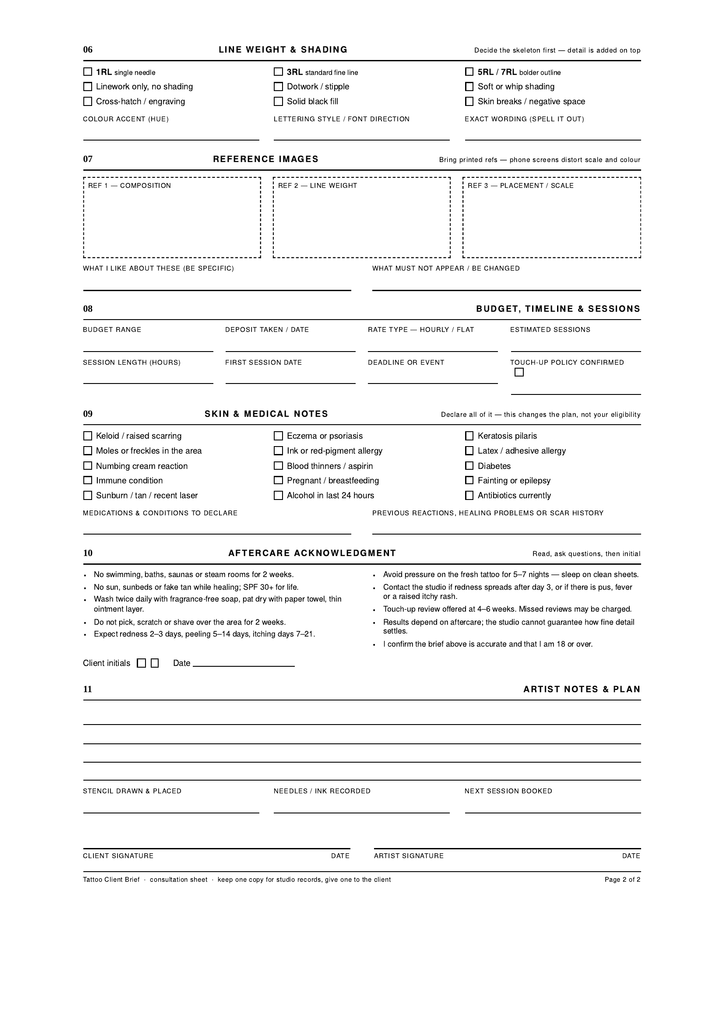
Your design brief: five questions to answer before you book
- Which zone — nape, between the blades, lumbar, or full length? This decides the design before the design does.
- Which family — script, botanical, ornamental, creature, or dark blackwork? Don’t mix three.
- What’s the anchor? Every good spine piece has one dominant element and support acts. If everything is the same size, nothing reads.
- Will it be visible in your normal wardrobe? Backless, scoop, or fully covered — decide deliberately.
- How will it look at year fifteen? Ask the artist to draw the minimum viable version: heaviest lines only. If you still like it, build the detail on top.
FAQ
Does a spine tattoo hurt?
Yes, more than most placements — thin skin directly over bone with dense nerve endings. The upper spine is more tolerable; mid and lower spine are sharper.
How much does a spine tattoo cost?
Reported ranges run roughly $150–$2,000 depending on size and detail, with small single-line designs at $150–$400 and many artists quoting around $300 for mid-size work. Confirm in writing before the session.
How long does a spine tattoo take to heal?
Surface healing in 2–4 weeks, full healing around 4–6 weeks, with deeper dermal recovery taking longer. Avoid sleeping on your back for the first week.
Should the text face left or right on a spine tattoo?
Match it to the direction you’ll naturally turn your head, or use stacked “ladder” lettering to avoid the question entirely.
Do fine line spine tattoos fade?
They soften as ink spreads in aging skin. Strong structural lines hold up far better than hairline detail, and overworked lines can drop ink during healing.
How long should I wait between sessions on a full back piece?
Most artists schedule in blocks that allow the previous session to heal — typically a few weeks. Your artist sets this, not the internet.
Can I get a spine tattoo as my first tattoo?
Plenty of people do, and the vertical structure is genuinely beginner-friendly in design terms. Just be aware it’s a more intense session than a forearm.
Is a lower back tattoo still in style?
Yes — 2026 trend coverage explicitly names the return of lower back pieces, with fine line and bold tribal treatments leading.
Designs shown are reference and concept imagery for briefing purposes, not finished stencils. Always have your artist redraw and proof the lettering before your appointment.
If you want me to keep going, the high-value follow-ons are: a companion post for each style family (e.g. “script spine tattoo: 20 quotes and where they sit”) so this page becomes the hub, a printable client brief sheet, or an image-set version of this article for Pinterest pins with keyword-matched titles.