The Short Answer
To reapply SPF over makeup without ruining your look, use an SPF mist, powder, or stick. Blot excess oil first, then dab or mist gently — never rub. Reapply every two hours when outdoors, or immediately after swimming, heavy sweating, or towelling off. For indoor days, a single morning application of 2 mg/cm² is usually sufficient.
Thank you for reading this post, don’t forget to subscribe!Your SPF Reapplication at a Glance
☀️ Morning (before makeup)
- Apply 2 mg/cm² of broad-spectrum SPF 30+
- Wait 60 seconds for it to settle
- Then apply makeup
🕐 Midday (over makeup)
- Blot excess oil with blotting paper
- Choose: SPF mist, powder, or stick
- Dab or mist gently — never rub
The rule: SPF is always the last step of skincare. Makeup goes on top. Then reapply over the top when needed.
In This Guide
- Why SPF Reapplication Matters
- How Much Sunscreen Should You Actually Apply?
- The Correct SPF Layering Order
- How to Reapply SPF Over Makeup
- SPF Formats Compared: Mist vs Powder vs Stick
- How Often to Reapply (The Honest Answer)
- How to Prevent Pilling
- SPF for Different Skin Types
- Common SPF Mistakes
- FAQs
- Sources & Evidence
Why SPF Reapplication Matters
Sunscreen is not a one-and-done product. It degrades, wears off, and gets physically removed throughout the day.
Research published in the Journal of the American Academy of Dermatology found that sunscreen coverage on the face declined by a mean of 18.31% within the first two hours of outdoor exposure. By the end of an eight-hour working day, the mean decrease reached 31.63%.
This happens for two reasons:
1. Chemical filters are consumed by UV exposure. Chemical UV filters like avobenzone absorb UV radiation and convert it into heat. That process is the point — it is how they protect you. But it also means the filters are gradually used up. The more UV exposure, the faster your protection drops.
2. Physical removal happens constantly. Every time you touch your face, rub your eyes, eat a meal, or blot your skin, you remove sunscreen. Sebum production dilutes it further — which is particularly relevant for oily and combination skin.
Mineral filters like zinc oxide and titanium dioxide are more photostable — they do not degrade the same way. But they are still subject to all the physical removal factors above.
The bottom line: A morning application does not last all day. Reapplication is essential for maintained protection.
How Much Sunscreen Should You Actually Apply?
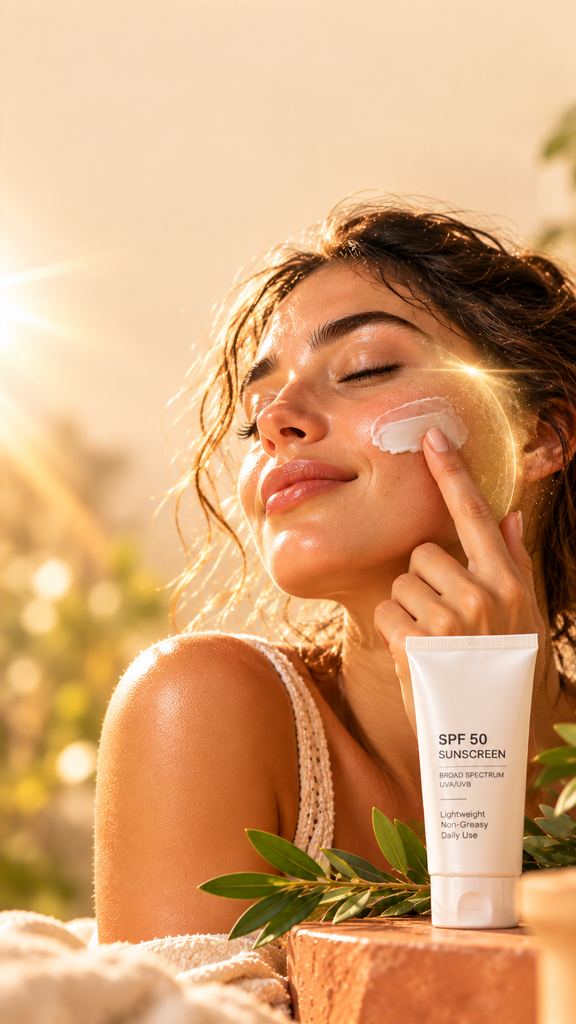
Most people apply only 25 to 50 percent of the recommended amount — which means they are getting significantly less protection than the SPF number on the bottle promises.
The correct amount for your face:
- The teaspoon rule: 1 teaspoon (5 mL) for the face, head, and neck
- The two-finger rule: Two finger-lengths of sunscreen for your face and neck
- The nickel-sized rule: Approximately a nickel-sized amount for the face alone
The FDA standard is 2 mg/cm² of exposed skin. For the average adult, that equates to about 30 mL (one ounce) for the whole body — roughly a shot glass.
What this means in practice: If you are using less than half a teaspoon on your face, you are probably not getting the SPF listed on the label.
The Correct SPF Layering Order
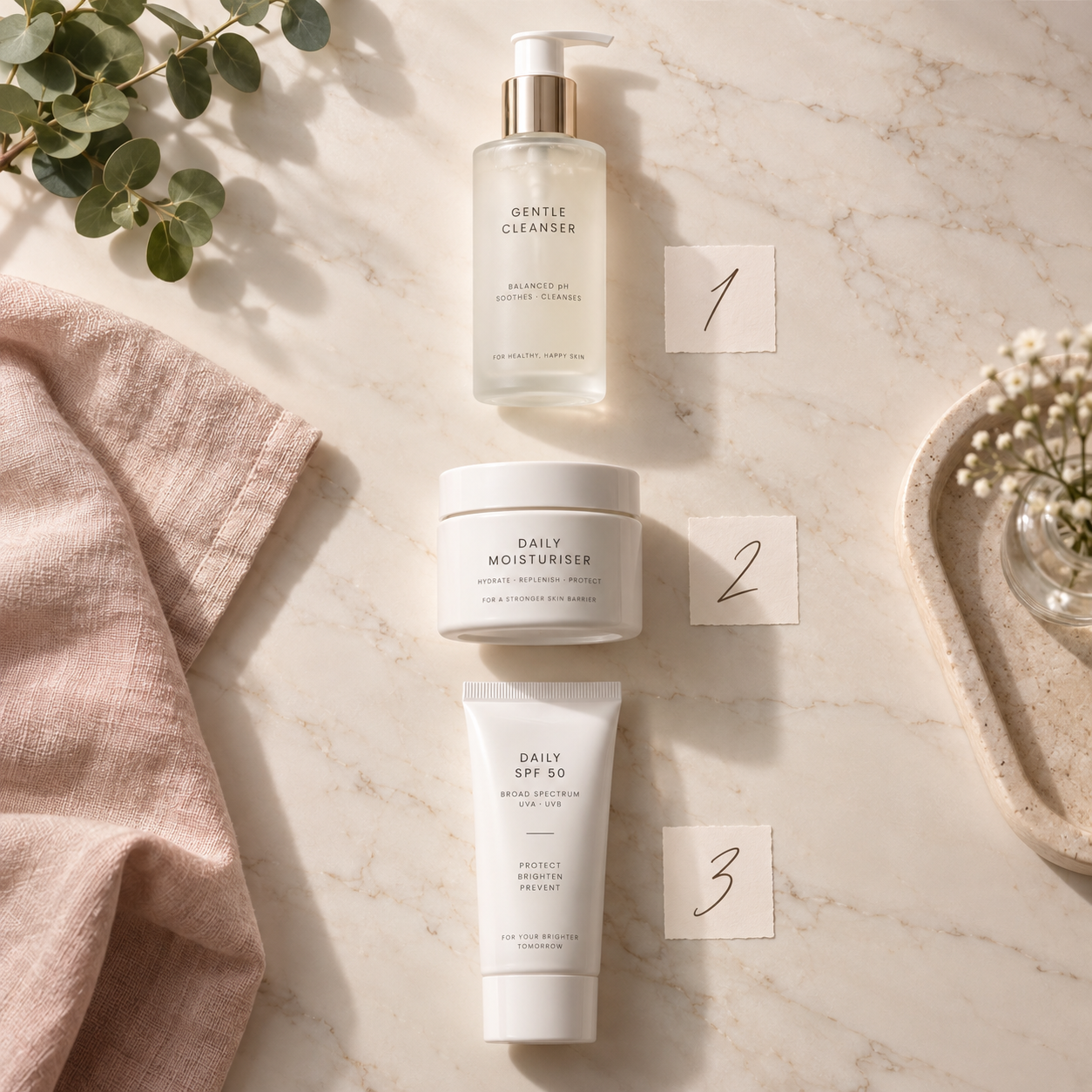
The American Academy of Dermatology recommends that sunscreen should be applied as the last step in your morning skincare routine.
Your morning order:
- Cleanser
- Toner / essence
- Treatment serum (vitamin C, niacinamide, etc.)
- Eye cream
- Moisturizer
- Sunscreen — always last
Then: Makeup goes on top of sunscreen, not underneath it.
Sunscreen needs to sit on top of your skincare as an even, undisturbed layer to form a protective film. Anything applied on top of it — including moisturiser — dilutes its filtration capacity.
Want the complete product-by-product sequence? See our skincare routine order guide for the exact morning and evening order.
How to Reapply SPF Over Makeup
Method 1: The Damp Beauty Blender
This is the most reliable method for reapplying sunscreen over a full face of makeup.
Steps:
- Dampen a beauty blender with a small amount of water — damp, not wet
- Dispense sunscreen onto the back of your clean hand
- Dab the sponge into the sunscreen
- Press — do not rub — the SPF into your skin using gentle dabbing motions
- Focus on high-exposure areas: nose, cheeks, forehead, chin
Why it works: The damp sponge presses the SPF into the skin without disturbing the makeup underneath. Dab, do not rub — rubbing breaks up both your SPF film and your makeup.
Method 2: SPF Mist
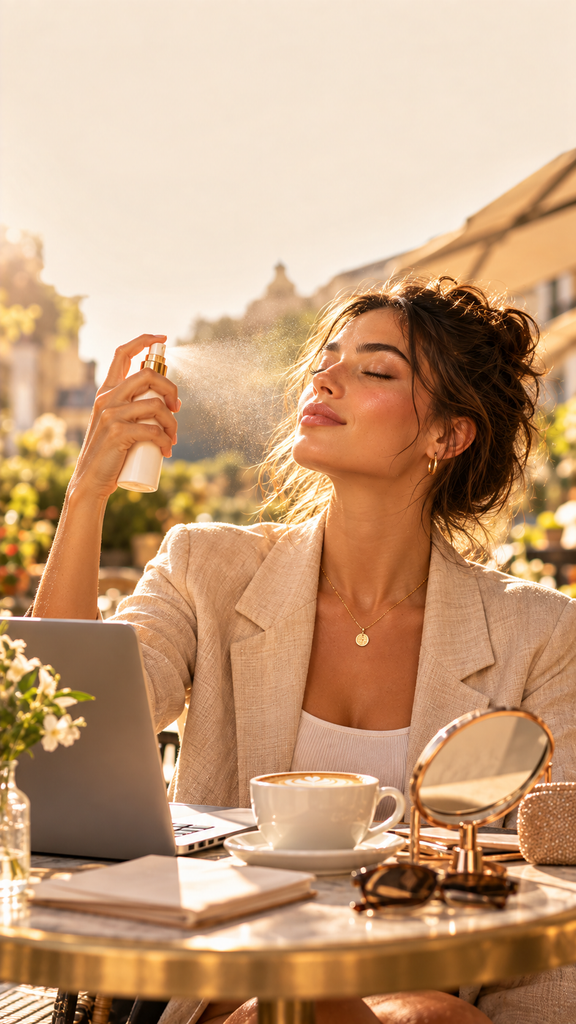
A sunscreen mist is the fastest and easiest option for midday reapplication.
Steps:
- Close your eyes and mouth
- Hold the bottle 8–10 inches from your face
- Spritz in circular motions across your face
- Allow the mist to settle fully before opening your eyes
- Do not inhale during application
Best for: People on the move, commuting, or spending extended time outdoors. Also ideal for anyone who runs warm or sweaty, since a fine mist offers real relief while protecting at the same time.
One caution: Many spray sunscreens contain denatured alcohol, which can irritate skin. Your foundation acts as a partial barrier, but still be careful if you have sensitive skin.
Method 3: SPF Powder
SPF powders are the most makeup-friendly reapplication format. They set, mattify, and protect all at once.
Steps:
- Blot excess oil first with blotting paper
- Use a large, soft brush
- Press — do not sweep — the powder onto your skin
- Focus on the T-zone and any shiny areas
Best for: Anyone wearing foundation, concealer, or base makeup who wants to maintain SPF without undoing their look. Also ideal for oily skin types who want to mattify and protect simultaneously.
Important: Powders alone will not hit your target SPF dosage. Always layer them over a cream or fluid base sunscreen applied in the morning.
Method 4: SPF Stick
SPF sticks are the most versatile format for on-the-go reapplication.
Steps:
- Swipe the stick directly across your skin — face, neck, hands, bridge of nose
- Blend gently with your fingertips
- Be careful to avoid smearing your makeup
Best for: Oily and combination skin, with many formulas delivering a matte finish. They fit easily into any bag and require no tools or mirrors since they are typically colourless.
One honest note: Some users find that sticks can take off makeup or tinted sunscreen if applied too aggressively. Test yours before relying on it for a full face of makeup.
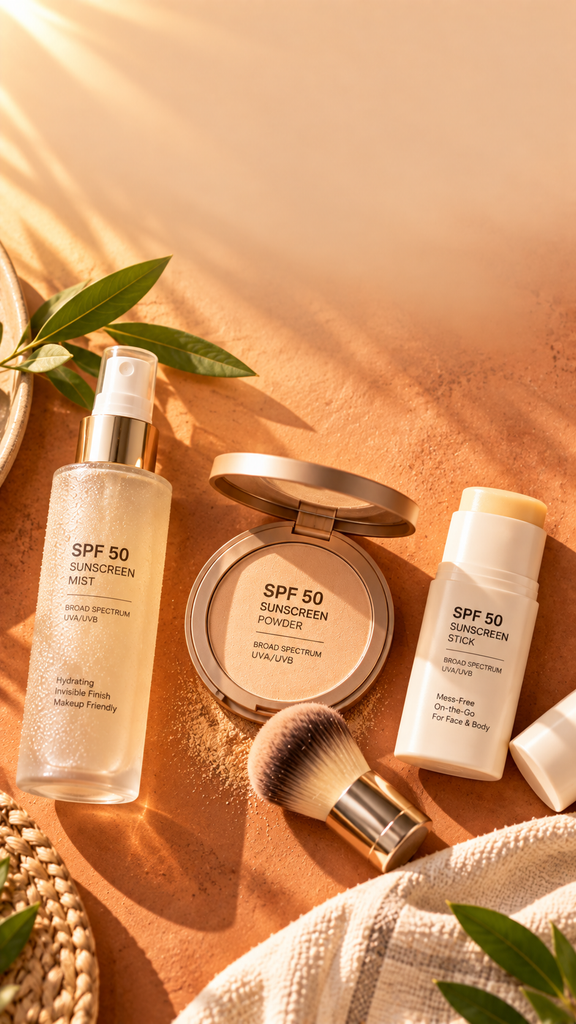
SPF Formats Compared: Mist vs Powder vs Stick
| Format | Best For | Pros | Cons | Water-Resistant? |
|---|---|---|---|---|
| Mist | On-the-go, commuting, sweaty skin | Fastest, refreshing, no tools needed | Can contain alcohol; may leave wet finish | No |
| Powder | Full makeup, oily skin, mattifying | Most makeup-friendly, sets and mattifies | Cannot reach full SPF alone; not water-resistant | No |
| Stick | Oily skin, precise areas, travel | Mess-free, portable, matte finish | Can smear makeup if applied too hard; may skip areas | Some formulas |
| Cream/Lotion | Full protection, dry skin, swimming | Highest protection, water-resistant | Hard to reapply over makeup | Yes |
The honest truth: No single format is perfect. The best reapplication format is the one you will actually use consistently. Many people keep a mist in their bag for quick touch-ups and a stick for targeted areas like the nose and hands.
How Often to Reapply (The Honest Answer)
The standard advice: Reapply every two hours.
But here is what most articles do not tell you:
Most sunscreens now on the market do not need to be reapplied every two hours, keeping their potency for 4 or even 6 hours after application — unless there is heavy sweating, significant friction, or exposure to water.
A practical framework:
| Situation | Reapplication Frequency |
|---|---|
| Indoors all day (office, home) | Single morning application is sufficient if 2 mg/cm² was applied |
| Intermittent outdoor exposure (commuting, errands) | Reapply every 2–3 hours |
| Continuous outdoor exposure | Reapply every 2 hours |
| Swimming or heavy sweating | Reapply immediately after, even if “water-resistant” |
| Towelling off | Reapply immediately after |
Research shows that users often apply more thoroughly and cover missed areas during their second application — reinforcing the value of reapplication even beyond the protection itself.
How to Prevent Pilling
Pilling happens when skincare products — serums, moisturisers, and sunscreen — do not have enough time to absorb before the next layer is applied.
How to stop it:
- Wait 60 seconds between each layer. This is the single most effective fix. Let your moisturiser settle before applying SPF.
- Apply thinner layers. Two thin passes are better than one heavy layer. Let the first settle before the second goes on.
- Pat, do not rub. Rubbing disrupts the protective film that sunscreen needs to form.
- Apply SPF to dry skin, not damp. Damp skin increases the risk of pilling and uneven coverage.
- Avoid layering too many heavy products. If you are using multiple thick formulas under your SPF, reduce the number. Less is more.
- Use a damp makeup sponge for foundation. A dry brush can drag the skincare formulas you have applied and cause pilling. A damp sponge presses instead of drags.
SPF for Different Skin Types
Oily & Acne-Prone Skin
Best formats: Gel-based chemical sunscreens, SPF powders, matte sticks
What to look for: Oil-free, non-comedogenic, mattifying
Product picks:
- Budget: Cetaphil Sheer Mineral SPF 30
- Mid-range: La Roche-Posay Anthelios UV Clear SPF 60
- Premium: Supergoop Unseen Sunscreen SPF 40
Supergoop Unseen Sunscreen has an oil-free, gel-to-powder texture with a velvety, mattifying finish that doubles as a makeup-gripping primer.
Dry Skin
Best formats: Cream or lotion sunscreens with hydrating ingredients
What to look for: Glycerin, hyaluronic acid, panthenol, ceramides
Product picks:
- Budget: CeraVe AM Facial Moisturizing Lotion SPF 50
- Mid-range: belif The True Cream Aqua Bomb Sunscreen SPF 45
- Premium: Shiseido Perfect Sun Protector Hydro Gel Cream SPF 50+
belif The True Cream Aqua Bomb Sunscreen functions as moisturizer and sunscreen in one step — a strong pick for anyone who finds most SPFs too tight or drying.
Sensitive Skin
Best formats: Mineral (zinc oxide or titanium dioxide) formulas, fragrance-free
What to look for: Gentle, non-irritating, no alcohol
Product picks:
- Budget: CeraVe Tinted Sheer Mineral SPF 30
- Mid-range: La Roche-Posay Anthelios UV Air SPF 50
- Premium: EltaMD UV Clear SPF 46
EltaMD UV Clear is the dermatologist-office standard — broad-spectrum coverage, 5% niacinamide to calm and even tone, and a weightless finish that layers well under makeup for nearly any skin type.
Want a more advanced routine? See our 7-step glass skin routine for a structured approach using accessible products.
Common SPF Mistakes
1. Applying too little.
Most people use 25–50% of the recommended amount. Use half a teaspoon for your face alone.
2. Applying SPF after makeup.
SPF is the last step of skincare, but makeup goes on top of SPF. If you apply SPF over makeup, you dilute both.
3. Skipping reapplication because “it’s cloudy.”
UV damage happens every day, through windows, through clouds, year-round.
4. Using SPF powder alone for full protection.
Powders are for touch-ups, not full application. Always start with a cream or fluid SPF in the morning.
5. Rubbing instead of pressing.
Rubbing disrupts the protective film. Press or dab gently — especially when reapplying over makeup.
6. Not waiting between layers.
Sixty seconds between each product is the single most effective way to prevent pilling.
7. Forgetting commonly missed areas.
Scalp, hairlines, ears, eyelids, lips, feet, and the backs of hands are frequently missed.
Frequently Asked Questions
How do I reapply SPF over makeup without ruining it?
Use an SPF mist, powder, or stick. Blot excess oil first, then dab or mist gently — never rub. A damp beauty blender pressed gently over the face is the most reliable method.
Can I use moisturiser with SPF instead of separate sunscreen?
Yes, if it provides broad-spectrum SPF 30+ protection and you apply enough of it. Many moisturisers with SPF are not applied at the full 2 mg/cm² dose, so a separate sunscreen is often more reliable.
What order do I apply SPF in my skincare routine?
SPF is the last step of your morning skincare routine. Apply it after moisturiser and before makeup.
How much sunscreen should I apply to my face?
Use approximately half a teaspoon (or two finger-lengths) for your face and neck. Research shows most people apply only 25–50% of the recommended amount.
Is SPF 30 enough for daily use?
Yes, SPF 30 provides sufficient protection for daily use. For extended outdoor exposure, the Skin Cancer Foundation recommends SPF 50+.
Does SPF powder actually work?
SPF powder is useful for touch-ups over makeup, but it cannot provide full protection on its own. Always layer it over a cream or fluid sunscreen applied in the morning.
How often should I reapply sunscreen if I’m indoors all day?
If you applied 2 mg/cm² in the morning and are not near windows or outdoors, reapplication is not strictly necessary. If you are near windows with direct sun exposure, reapply every 2–3 hours.
Sources & Evidence
- Journal of the American Academy of Dermatology — Sunscreen coverage decline study
- CMAJ — Five things to know about sunscreens
- The Skin Cancer Foundation — Ask the Expert: How to Apply Sunscreen
- CMAJ — Sunscreen reapplication frequency
- American Academy of Dermatology — Sunscreen application and SPF 30+ recommendation
- Typology — How to reapply sunscreen after makeup
- Paula’s Choice — Touching up sunscreen over makeup
- Tira Beauty — Sunscreen powders, sticks, and sprays
Last updated: September 26, 2026
Continue Your Skincare Routine
Start here:
→ SPF Reapplication Guide (this article)
Next:
→ Skincare Routine Order
If your barrier is irritated:
→ Skin Barrier Repair Routine
Want a simpler routine:
→ Minimalist Skincare Routine
Want glass skin:
→ Glass Skin for Beginners
Exploring new ingredients:
→ PDRN Skincare Guide
The Bottom Line
SPF reapplication is the step everyone skips — but it is also the step that determines whether your morning application actually protects you.
The formula:
- Apply 2 mg/cm² in the morning
- Wait 60 seconds
- Then apply makeup
- Reapply every 2 hours when outdoors
- Use mist, powder, or stick over makeup
- Never rub — always press or dab
Your skin will thank you. And so will your future self.
This article is for informational purposes and is not a substitute for professional medical advice. If you have persistent skin concerns, consult a board-certified dermatologist.
Related posts:
 Your Ultimate Guide to Stunning Hairstyles: From Classic to Cutting-Edge
 ✨ 17 Balayage Ideas for Long, Layered Brunette Hair with Face Framing ✨
 🌿 The Ultimate Guide to Hair Growth: Proven Tips, Foods & Natural Remedies for Faster, Healthier Hair
 The Exact Skincare Routine Order for Morning and Night (Finally Explained Clearly)