
By Polia · Relationships & Intimacy
Thank you for reading this post, don’t forget to subscribe!Here’s something nobody really says out loud:
Most women don’t feel naturally, effortlessly confident in bed. Not even the ones who look like they do. Not even the ones who’ve been with the same person for years. Not even the ones whose bodies look exactly like the ones in the magazines.
Confidence in the bedroom is not a personality trait you’re born with or a body type you earn. It’s a practice. It’s something that gets built — through small shifts in how you think, how you move, how you treat yourself before you ever get there.
And the women who seem like they have it figured out? They’ve usually just done more of that work than they let on.
This post is about that work. Not the fake-it-till-you-make-it version — the kind of confidence that lives entirely in performance and falls apart the moment the lights come on. But the real kind. The kind that comes from actually knowing yourself, being present in your body, and choosing — deliberately — to stop making your own pleasure conditional on looking perfect.
Because here’s what I want you to hold onto before we go any further:
Your body, right now, as it is today, deserves to be fully present in its own pleasure. Not once you’ve lost the weight, not once your skin clears up, not once your stomach is flatter or your thighs are smaller. Right now.
That’s not a pep talk. That’s the actual foundation of everything in this post.
Why confidence in bed feels so hard

Before we get into the how, it helps to understand the why — because the reason most women struggle with this isn’t vanity or insecurity in the shallow sense. It’s something more specific.
We’ve been taught to experience our bodies primarily from the outside in.
We’ve absorbed thousands of images of what “sexy” looks like — a very specific, very narrow set of bodies, in very specific lighting, in very specific poses. And somewhere along the way, most of us started watching ourselves in bed the same way we watch ourselves in the mirror. Checking. Evaluating. Wondering what we look like from that angle.
Psychologists actually have a name for this: spectatoring. It’s when you mentally step outside your own experience and observe yourself from a third-person perspective — essentially becoming your own audience during what should be one of the most present, embodied experiences possible.
Spectatoring is the thing that pulls you out of the moment. It’s what makes you adjust the sheets to cover your stomach or keep your shirt on or turn the lights off. It’s what turns something that should feel good into something that feels like a performance you might fail.
The antidote isn’t to decide you love every inch of yourself overnight. It’s to stop watching and start feeling. To move your attention from the outside of your body to the inside of it.
Everything in this post is aimed at exactly that.
1. Start before you get there
Confidence in bed is almost never something that suddenly switches on at the right moment. It’s a state you arrive in — which means you build it before you even get to the bedroom.
Your body relationship on an ordinary Tuesday matters. How you talk to yourself when you’re getting dressed. Whether you allow yourself to enjoy the physical sensations of a good meal, a hot shower, a stretch that releases something. Whether you touch your own skin with any kind of tenderness or purely with critique.
Women who feel embodied and sensual in intimate moments tend to practice embodiment in small ways throughout the day. They’re not performing confidence for someone else — they’ve just built a habit of being present in their bodies generally, so it’s not a foreign state to access when it matters.
Start small. Let yourself enjoy physical sensations without immediately evaluating them. Notice what your body can do and feel rather than cataloguing what it looks like. This sounds disconnected from the bedroom but it is, genuinely, the foundation.
2. Get out of your head and into your body — literally

Spectatoring happens in your head. The way back is through your senses.
When you notice your mind drifting into evaluation mode — does my stomach look okay, what does he think, I should have worn the other thing — it’s not a moral failure. It’s just a habit of attention. And you can redirect it.
The redirect is always physical. What can you feel right now? Not what does it look like, what does it feel like. The warmth of skin, the weight of a hand, your own breath, the temperature of the room.
This sounds simple because it is. But it requires practice, especially if you’ve spent years living mostly in your head during intimate moments. The first few times you try to redirect your attention back to sensation, your brain will resist. That’s normal. Keep bringing it back.
One practical thing that helps: slow everything down deliberately. Not for effect, but because slower movement gives your nervous system more time to actually register sensation. When you’re rushing — consciously or unconsciously — you skip past the parts that feel good and stay in your head. Slowing down is a physiological shortcut back into your body.
3. Wear something that makes you feel like yourself
This is not about lingerie. Let me say that again: this is not about lingerie.
It’s about the specific, personal experience of feeling good in what you have on — or don’t have on — in a way that comes from the inside rather than from performing a role.
For some women, that is lingerie. For others it’s a specific soft t-shirt, or nothing at all, or a particular pair of underwear that fits exactly right. For some it’s candlelight and a clean room. For some it’s being freshly showered. For some it’s none of those things — it’s just a specific emotional state they need to arrive in.
Figure out what your version of that is. Not what you think it should be, not what looks good in photos, not what a partner has mentioned — what actually, in your own private experience, shifts you into feeling more like the version of yourself that feels sensual and present.
Then create those conditions deliberately, as often as you can. Confidence has a setup. Find yours.
4. Know what you actually like — and let yourself like it
This is the one most women skip, and it’s probably the most important.
You cannot feel confident about something you don’t understand. And a lot of women are trying to show up fully in intimate moments while still being relatively unfamiliar with their own bodies, their own pleasure, and what they actually want.
This is not a criticism — it’s a structural problem. Women are rarely encouraged to explore what feels good for them specifically, independent of a partner’s experience. The cultural narrative around women’s pleasure is almost always framed in terms of what someone else wants to give or receive. Your own pleasure, your own curiosity, your own understanding of your body — that tends to get treated as secondary or even selfish.
It isn’t. It’s the foundation.
When you know what you like — not in theory, in your actual experience — you show up to intimacy with a kind of groundedness that is completely different from performance. You’re not hoping things work out. You’re bringing something specific and real. That is confidence in its most genuine form.
Take the time to actually know yourself. Treat it as something worth knowing.
5. Stop performing and start communicating

There’s a version of “confidence” in bed that’s actually just performance — doing the things you think look or sound good, staying quiet about what isn’t working, making sure your partner is having a good time while staying almost completely disconnected from your own experience.
That version is exhausting. And it’s not confidence — it’s theater.
Real confidence in bed looks like being able to say what you want. Not in a scripted or rehearsed way — just casually, naturally, as part of the experience. “I like this more than that.” “Can we try it this way?” “That feels really good, don’t stop.”
I know. Easier said than done, especially if you’ve been socialized to prioritize a partner’s experience over your own, or if you’re worried about seeming demanding or needy or too particular.
But here’s the thing: expressing what you want is one of the most genuinely confident things you can do, and most partners respond to it with enthusiasm rather than discomfort. Being with someone who knows what they want and can communicate it clearly is far more engaging than being with someone who’s quietly hoping things work out.
You don’t need to make it a production. Start small. One thing, one time. Notice how it lands. It almost always lands better than you expected.
6. Reframe what “sexy” actually means to you
Sexy as defined by a thin slice of media, diet culture, and early 2000s magazine covers is genuinely not helpful to you here. That definition was never about your pleasure or your experience — it was about being evaluated by an external audience.
Sexy as you actually experience it is a completely different thing.
Think about a moment when you genuinely felt it — not performed it, felt it. What was the context? What were you wearing, doing, with whom, under what circumstances? What was it about that moment that made you feel that way?
I’d be willing to bet it had more to do with feeling present, safe, seen, and fully yourself than with how you looked in a mirror.
That’s the definition worth working from. Not the external one — the internal one. The version that belongs to your actual experience of your own body and your own desires.
Write it down if it helps. Name what makes you specifically feel sensual and alive. Then orient more of your life and your intimate moments around that instead.
7. Let go of the highlight reel comparison
Social media, film, television — they have given us extraordinarily unrealistic reference points for what intimacy looks like. Perfect lighting, perfect bodies, perfect responses, nobody ever pausing to laugh about an awkward moment or adjust a position or deal with the completely normal reality of two human bodies sharing a physical space.
Real intimacy has moments that are ungraceful, funny, imperfect, and sometimes a little awkward. That doesn’t mean something went wrong. That means you’re having a real experience with a real person rather than performing a scene.
The women who feel most confident in intimate situations are almost always the ones who’ve given themselves permission to be human in them — to laugh when something is funny, to adjust without making it mean something, to not take their own imperfections with crushing seriousness.
Lightness is not the opposite of intimacy. Sometimes it’s exactly what makes it feel real.
8. Care for your body in ways that build trust
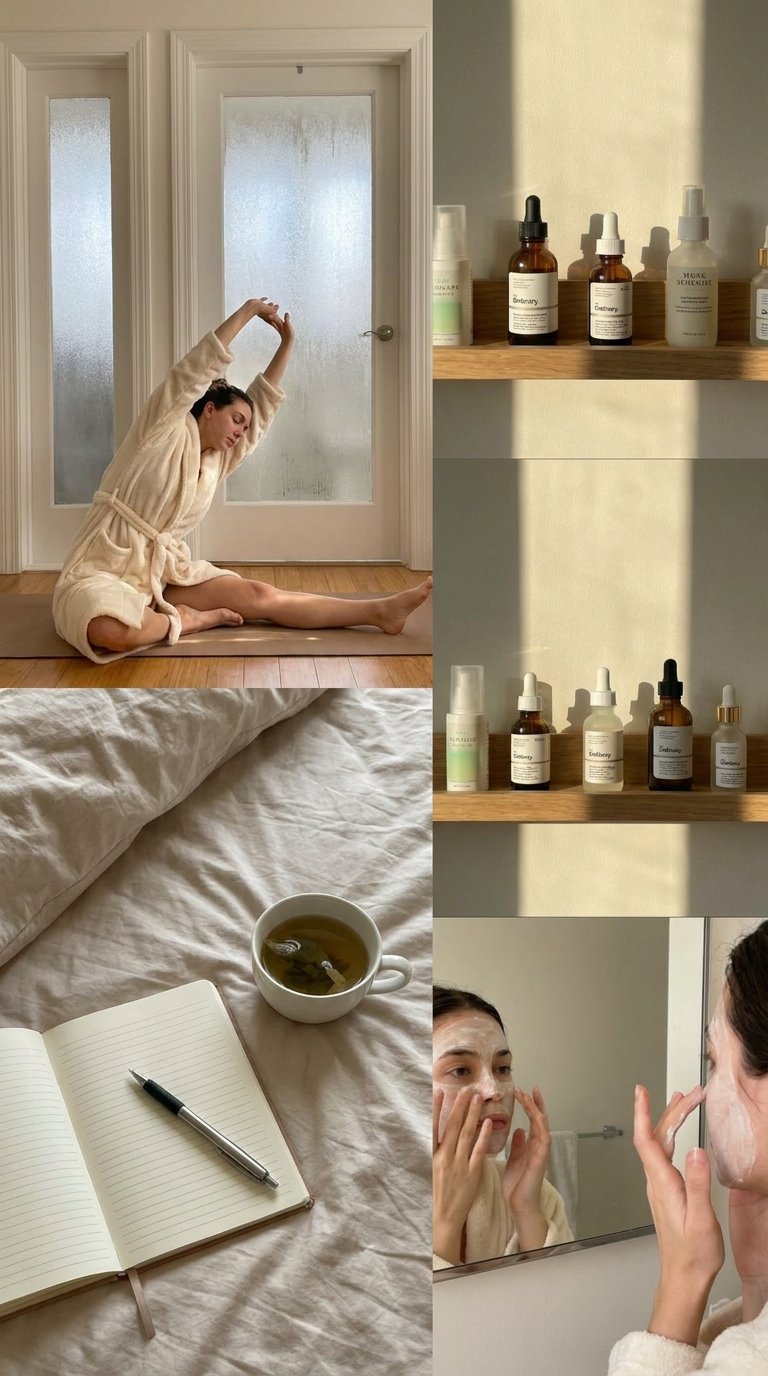
This is different from changing your body to meet a standard. This is about doing things for and with your body that build the internal experience of feeling good in it.
Movement that makes you feel strong and alive rather than punished. Sleep that actually restores you. Nutrition that makes you feel good rather than depleted. Touch — your own or someone else’s — that is kind rather than evaluative.
When you treat your body as something that deserves care, your relationship with it shifts over time. Not overnight — but gradually, the internal experience of inhabiting your body starts to feel more like home and less like a performance space.
That shift is quiet but it’s real. And it shows up, eventually, in how you feel in intimate moments — not because you’ve changed what your body looks like, but because you’ve changed how it feels to live in it.
9. Know that confidence is not the absence of insecurity
This is the thing I most want you to hear.
Every woman — every single one — has moments of insecurity in intimate settings. The question isn’t whether you feel it. The question is whether you let it run the show.
Confident women in bed aren’t women who have no self-doubt. They’re women who have learned to feel the doubt and not let it become the loudest voice in the room. They can notice the thought — I don’t love this angle — and gently return their attention to sensation. They can have the moment of hesitation and still choose to be fully present.
That is the practice. Not eliminating the insecurity. Choosing presence anyway.
You won’t get it right every time. There will be evenings when the doubt wins and you spend more time in your head than in your body. That’s okay. You come back the next time and you practice again.
It genuinely does get easier. Not because the doubt disappears, but because you get better at not listening to it.
10. Give yourself permission to want things
This might be the quietest revolution in this whole post, and it’s the one that changes the most.
Women are not well served by the cultural narrative around desire. We’re taught to be desirable — to be wanted — far more than we’re taught that wanting is equally valid, equally worthy, equally worth expressing.
But desire is not something that happens to you. It’s something that lives in you. And your pleasure, your curiosity, your wanting — these are not supporting characters in someone else’s experience. They are the main event of your own.
Give yourself permission to want things. To ask for them. To know what they are. To show up to intimacy as someone with her own needs and desires that matter as much as anyone else’s in the room.
That is, at its core, what sexual confidence actually is. Not a body type. Not a performance. Not the absence of insecurity.
Just a woman who knows she’s allowed to be fully there.
The short version: 10 things to practice
If you want to bookmark this and come back to it in the moment, here’s the essence:
- Build body presence in small ways every day — not just in the bedroom
- When your mind wanders into evaluation, redirect to physical sensation
- Create the specific conditions that actually make you feel like yourself
- Know your own body — genuinely, in your own experience, not in theory
- Communicate what you want — start small, one thing at a time
- Reframe sexy around your internal experience, not an external standard
- Let intimacy be imperfect and human — lightness is not the enemy of depth
- Care for your body in ways that build trust, not pressure
- Let insecurity exist without letting it lead
- Know that your wanting matters as much as anyone else’s in the room

FAQs: Feeling confident and sexy in bed
What if I genuinely can’t stop thinking about my body during sex?
You’re describing spectatoring, and it’s very common — especially for women who’ve experienced body image struggles, trauma, or a long period of feeling disconnected from their bodies. The redirect technique (consciously moving attention from how you look to what you feel) helps, but it takes consistent practice. If it’s significantly impacting your quality of life and intimate relationships, speaking with a therapist who specializes in body image or intimacy can be genuinely transformative — this is exactly the kind of thing therapy is built for.
Does confidence come more naturally with a long-term partner?
Sometimes, but not automatically. Long-term relationships can build the safety and familiarity that makes confidence easier — or they can build ingrained habits of spectatoring and performance that feel even harder to shift because they’re established. What actually builds confidence over time is the same regardless of relationship length: presence, communication, and treating your own pleasure as something worth prioritizing.
What if my partner makes me feel self-conscious?
This matters. A partner who makes comments — even casual, even “joking” — about your body or your responses creates an environment where confidence becomes much harder to access. You deserve intimacy with someone who makes you feel safe and celebrated, not evaluated. If this is a pattern in your relationship, it’s worth addressing directly — not as an accusation, but as a clear statement of what you need to feel good in this space. If the pattern continues after that conversation, that’s important information about the relationship.
Is it normal to feel more confident sometimes than others?
Completely. Confidence in intimacy fluctuates with how you’re feeling generally — your stress levels, your sleep, your relationship with your body that week, where you are in your cycle, what happened that day. There will be evenings when everything clicks and evenings when you’re mostly in your head. Both are normal. The goal isn’t consistent peak confidence every time — it’s a gradual shift in the baseline over time.
How do I start communicating what I want if I’ve never really done that before?
Start with affirmation before direction. Instead of “I don’t like that,” try “I love it when you…” or “that feels so good when you…” Positive framing is easier to give and easier to receive, especially at first. As it gets more comfortable, you can add more specific asks. The first time you do it, it will feel vulnerable. Do it anyway. The relief on the other side of that vulnerability is worth it.
One last thing
Your body is not a problem to be solved before you’re allowed to enjoy it.
It is the whole instrument of your pleasure, right now, exactly as it is. And it deserves to be treated that way — by you, and by anyone you choose to share it with.
That’s not a standard you have to earn. It’s just the truth.
Feeling close to someone starts long before the bedroom — [here are 150 deep questions to ask your boyfriend that build real intimacy from the inside out.]
And if you’ve been wondering whether what you have with someone is headed somewhere real, [here are the 11 signs he wants a relationship, not just the physical part.]
Want to understand the connection between your stress levels and your desire? [Here’s what high cortisol is actually doing to your sex drive — and how to fix it.]
Category: Relationships & Intimacy
© Polia.blog — Written with love and honesty, always.